
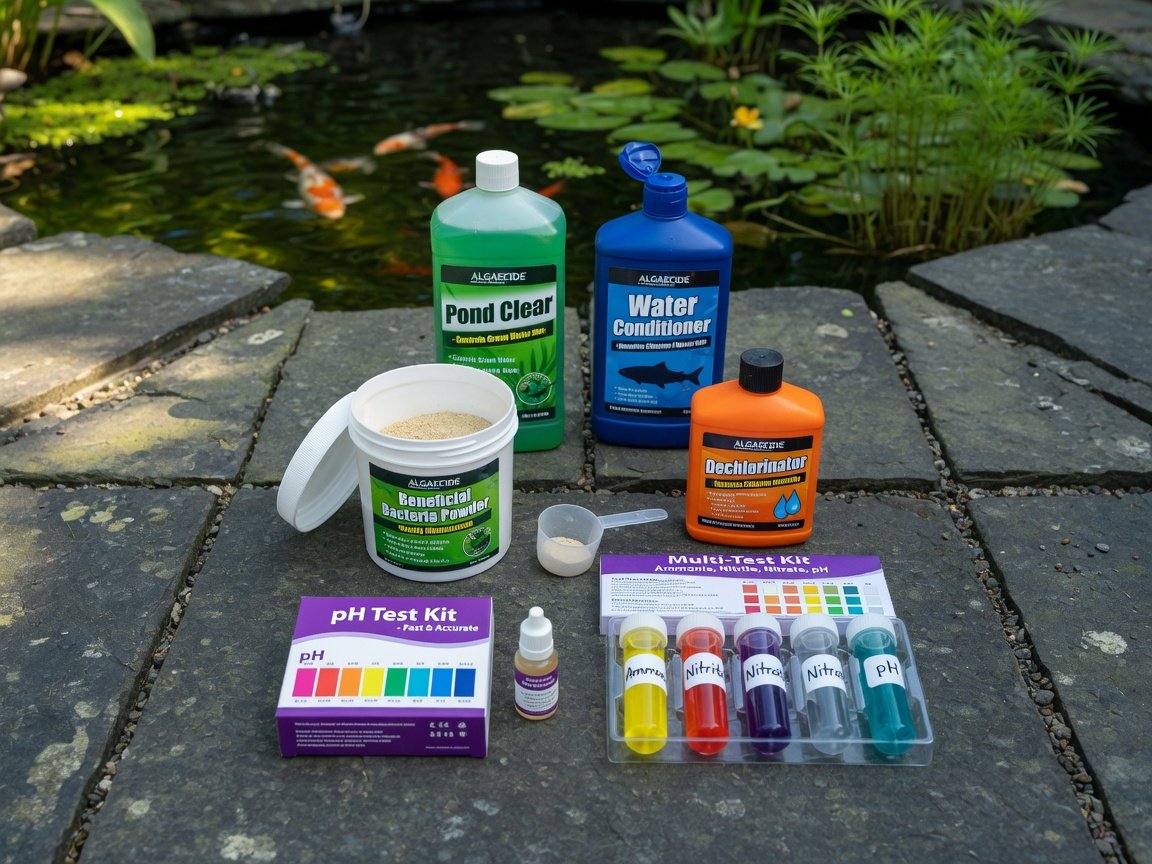
Pond treatment chemicals divide into six categories: algaecides, biological treatments, water clarifiers, dechlorinators, pH adjusters, and ammonia detoxifiers. The right choice depends entirely on what your water test reveals — applying the wrong chemical, or an overdose of the right one, can harm the fish and plants you are trying to protect.
Some of the links in this article may be affiliate links. If you make a purchase through these links, we may earn a small commission at no extra cost to you. Thank you.
Key Takeaways
- Six core categories cover virtually every pond water problem — from algae blooms and cloudiness to dangerous ammonia spikes and pH drift.
- Test before you treat. Applying a chemical without first measuring pH, ammonia, nitrite, and nitrate turns a manageable problem into a costly one.
- Biological and chemical treatments serve different roles. Chemicals correct imbalances fast; beneficial bacteria sustain long-term water quality.
- Seasonal timing is critical. Several common treatments are ineffective in cold water, and some deplete dissolved oxygen dangerously during summer heat.
What Are Pond Treatment Chemicals and Why Does Every Pond Need Them?
A garden pond is a closed or semi-closed ecosystem. Unlike a river or lake, it lacks the natural flushing, dilution, and biological diversity that keep large water bodies in balance. Fish waste, decaying organic matter, rainfall run-off, and tap water all introduce compounds — ammonia, chlorine, phosphates, excess minerals — that accumulate steadily over time and tip water chemistry outside the range where fish and plants thrive.
Pond treatment chemicals are formulated products designed to correct these imbalances quickly, support beneficial biological processes, or eliminate specific threats such as algae and pathogens. They are not a substitute for good husbandry — appropriate stocking levels, regular partial water changes, and adequate filtration all reduce how often you will need them. But even a well-maintained pond will occasionally require chemical intervention, particularly when conditions shift rapidly with the seasons or when a new pond is still establishing its biological filter.
The guiding principle is targeted treatment. Reaching for a broad-spectrum chemical without knowing the cause of a problem is counterproductive. Always test your water first, then select the product that addresses what your test actually reveals. This one discipline — test, identify, treat — separates effective pond management from the guesswork that leads to repeat chemical use and persistently poor water quality.
How Do Algaecides Work and When Should You Use Them?
Algaecides target the cellular processes that sustain algae growth. The most commonly used active ingredients fall into three groups: copper compounds (including copper sulfate and chelated copper formulations), hydrogen peroxide-based products, and natural extracts such as barley straw extract. Each works through a different mechanism and suits different algae types — choosing the right one for your specific problem matters considerably.
Copper-based algaecides are effective against many forms of green water — the phytoplankton blooms that turn pond water pea-soup green — and against some filamentous algae. They work by disrupting enzyme activity in algal cells. Their critical limitation is toxicity to fish at elevated concentrations, particularly in soft water where copper becomes more bioavailable. Chelated copper products bind copper to a carrier molecule that releases it more slowly, reducing this risk while extending effectiveness over a longer period.
Hydrogen peroxide treatments release reactive oxygen species that damage algal cell membranes. They break down into water and oxygen, leaving no persistent chemical residue — a significant advantage where fish and invertebrate safety is a priority. Dosing precision matters: excess hydrogen peroxide depletes dissolved oxygen and stresses fish. Always treat in portions rather than a single calculated dose, and keep aeration running throughout.
Barley straw extract is a slow-acting, natural option. It does not kill existing algae — instead, it is thought to inhibit new growth by releasing compounds as organic material decomposes in the water. It performs best as a preventive measure, applied in early spring before algae establishes rather than once a bloom is already underway. For a detailed breakdown of which treatments perform against specific algae types, this head-to-head comparison of pond algae treatments by algae type covers blanketweed, green water, and filamentous algae separately.
What Are Biological Pond Treatments and How Do They Differ from Chemical Ones?
Biological treatments introduce or supplement populations of beneficial microorganisms — primarily nitrifying bacteria from the genera Nitrosomonas and Nitrobacter — that process harmful compounds in the water column. Rather than attacking a problem directly, they build the biological infrastructure that prevents problems from recurring. This is their fundamental distinction from chemical treatments, and why they belong in every pond keeper’s long-term management plan.
The nitrogen cycle is central to understanding why these products matter. Fish excrete ammonia continuously. Nitrifying bacteria convert ammonia to nitrite, then nitrite to the comparatively harmless nitrate. Without a healthy, established bacterial colony — typically housed within the filter media — ammonia and nitrite accumulate to toxic levels even in a pond that looks clear and healthy. A thorough understanding of how nitrogen functions in a pond ecosystem makes clear why biological treatments are foundational to water quality, not just an optional extra.
Beneficial bacteria products are available in liquid, powder, and gel formulations. They perform best when water temperature exceeds approximately 10°C. Below this threshold, bacterial metabolic activity slows significantly — some manufacturers produce cold-water formulations designed for lower temperatures, which are worth having on hand for spring pond restarts. Biological treatments are also sensitive to UV sterilisers: switch your UV unit off for 48 hours after dosing to allow bacteria to establish in the filter before UV light can destroy them before they settle.
Biological and chemical treatments are not alternatives — they are partners. If ammonia spikes to a dangerous level, a chemical detoxifier buys critical time while the bacterial colony recovers or establishes. The bacteria then take over long-term management. Using chemicals without building a biological foundation means treating symptoms indefinitely without ever resolving the underlying cause.
How Do Water Clarifiers and Flocculants Clear Murky Pond Water?
Pond clarifiers work through flocculation — causing fine suspended particles to clump together into larger aggregates that either sink to the pond floor or are captured by the filter. The result is visibly clearer water, sometimes within hours of a single treatment. They are among the most immediately satisfying chemicals to use, which is why they are also among the most frequently misused.
Two main types are used in pond keeping. Polymer-based clarifiers use synthetic flocculants that bind negatively charged particles — clay, tannins, fine detritus — and pull them out of suspension. Aluminium sulfate (alum) is an older but still widely used alternative that works similarly, but requires careful pH management: it can lower pH significantly in soft water, potentially stressing fish in the process. Most modern pond clarifiers use polymer chemistry to avoid this risk while retaining reliable effectiveness.
Clarifiers treat the symptom, not the cause. Chronically murky water usually indicates overstocking, poor filtration, a heavy organic load, or a nutrient imbalance fuelling algae growth. Clarifiers restore visual clarity while you address the underlying problem — they will not maintain clear water on their own. After treatment, remove the settled material from the pond floor promptly to prevent it releasing nutrients back into the water column and restarting the cycle.
How Do Dechlorinators and Water Conditioners Protect Your Fish?
Tap water in the UK and most Western countries is treated with chlorine or chloramines to make it safe for human consumption. Both compounds are acutely toxic to fish even at low concentrations — they damage gill tissue and disrupt the fish’s ability to regulate the balance of salts in their body. Any time you add tap water to a pond, whether for a routine top-up during a dry spell or a partial water change, dechlorination is not optional.
Sodium thiosulfate is the simplest and oldest dechlorinator. It neutralises free chlorine rapidly through a direct chemical reaction. Its limitation is that it does not neutralise chloramines — a compound formed by combining chlorine with ammonia, increasingly used by water authorities because it is more stable in the distribution system than chlorine alone. Modern broad-spectrum water conditioners use additional chelating agents to neutralise chloramines, and often bind heavy metals, support the fish’s protective mucus coat, and detoxify low levels of ammonia simultaneously.
Check with your local water supplier whether your tap water is treated with chlorine or chloramines. This single piece of information determines which dechlorinator you actually need. Using a chlorine-only product where chloramines are present provides incomplete protection. If you are unsure, a full-spectrum conditioner is the safer default and costs little more than a basic dechlorinator.
| Chemical Category | What It Targets | Common Active Ingredients | Key Precaution |
|---|---|---|---|
| Algaecide | Algae (green water, blanketweed, filamentous) | Chelated copper, hydrogen peroxide, barley straw extract | Dying algae deplete oxygen — run extra aeration throughout treatment |
| Biological treatment | Ammonia and nitrite (via bacterial colony) | Nitrosomonas, Nitrobacter bacterial strains | Ineffective below ~10°C; UV steriliser destroys bacteria — switch it off for 48 hours |
| Water clarifier / flocculant | Suspended particles, persistent cloudiness | Polymer flocculants, aluminium sulfate | Treats the symptom only — remove settled waste from the floor after treatment |
| Dechlorinator / conditioner | Chlorine, chloramines, heavy metals | Sodium thiosulfate, EDTA, chelating agents | Match the product to your water treatment type — chlorine-only products fail against chloramines |
| pH adjuster | pH that is too acidic or too alkaline | Sodium bicarbonate (raise), sodium bisulfate (lower) | Never shift more than 0.5 pH units per hour — rapid change causes osmotic shock |
| Ammonia / nitrite detoxifier | Emergency ammonia or nitrite spikes | Zeolite, bound-ammonia detoxifiers | A temporary fix only — find and address the root cause before the effect wears off |
How Do You Balance Pond pH Safely Using Chemicals?
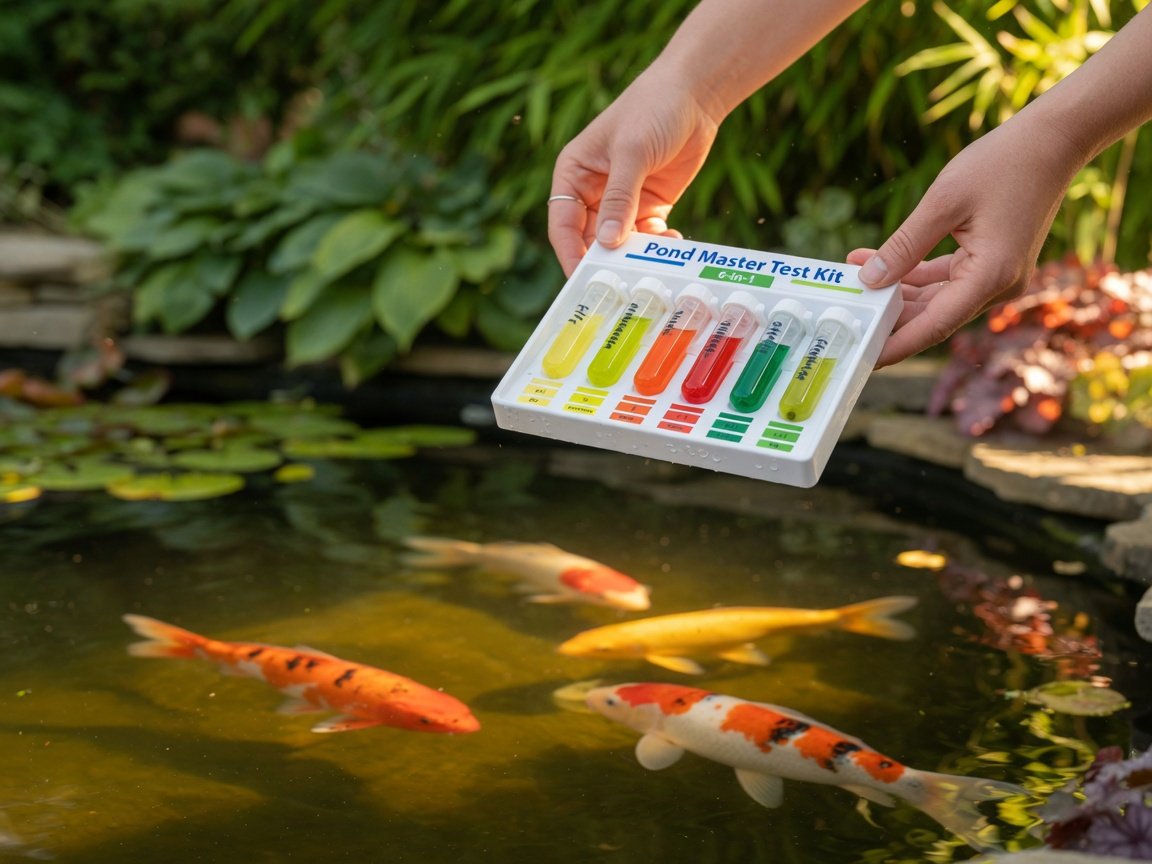
pH measures how acidic or alkaline your pond water is, on a scale of 0 to 14. Most pond fish — including koi and goldfish — thrive in a range of approximately 7.0 to 8.5. Outside this band, fish experience physiological stress; at extremes, it becomes lethal. pH also directly affects ammonia toxicity: at higher pH values, a greater proportion of the ammonia present in the water exists in its un-ionised (most toxic) form, meaning an ammonia problem and a high-pH problem compound each other dangerously.
To raise pH, sodium bicarbonate (bicarbonate of soda) is the most widely recommended option for garden ponds. It also raises carbonate hardness (KH), which acts as a natural pH buffer — stabilising pH and preventing the wild swings that can occur between morning and evening as aquatic plants and algae photosynthesise through the day. Specialist pond pH-up products containing sodium bicarbonate or calcium carbonate are commercially available and preferable to pool-grade equivalents, which may contain additives harmful to fish.
To lower pH, sodium bisulfate or purpose-made acidic pond pH-down products can be used carefully. Reducing pH is less commonly required in UK ponds than raising it, but may be necessary in areas supplied with very alkaline tap water. The non-chemical alternative — placing peat within filter media or directly in the pond — lowers pH gently and naturally over time, though without the same level of control or precision as a measured chemical dose.
The single most important rule with any pH adjustment is to change it slowly. A shift of more than 0.5 pH units per hour is widely considered sufficient to cause osmotic shock. Split treatments across several hours or even days, and retest after each addition before adding more. Patience with pH management saves fish.
What Are Your Options When Ammonia or Nitrite Spikes?
Ammonia and nitrite spikes are pond emergencies. Both compounds are toxic to fish at low concentrations, and both indicate that the biological filter has been overwhelmed, is newly established, or has been knocked back. Common triggers include power cuts that shut down pumps and filters, a dose of antibacterial treatment that eliminates beneficial bacteria, a sudden increase in fish numbers, or a build-up of decaying organic matter that overwhelms the filter’s processing capacity.
Zeolite is a naturally occurring mineral used in pond filtration and emergency ammonia-reduction products. It physically adsorbs ammonium ions from the water, providing rapid relief without adding chemicals to the system. Its capacity is finite — it must be recharged in a salt solution periodically or replaced — but as an emergency tool during a spike or a new pond cycle, it is highly effective. One important limitation: zeolite’s effectiveness reduces in higher-salinity water, so it should not be used alongside pond salt treatments.
Liquid ammonia detoxifiers convert toxic free ammonia into a bound, non-toxic form that beneficial bacteria can still process but which does not harm fish directly. They do not remove ammonia from the water — they neutralise it temporarily while the biological filter catches up. This distinction matters when interpreting test results: many ammonia test kits detect both free and bound forms, so readings may still appear elevated after the chemical has provided meaningful protection.
Large, immediate partial water changes — replacing 20 to 30 per cent of pond volume with freshly dechlorinated water — remain one of the fastest and safest ways to dilute a dangerous spike. Chemical treatments support this response; they do not replace it. If fish are visibly distressed — gasping at the surface or swimming erratically — carry out the water change first, before reaching for a chemical detoxifier.
How Do You Apply Pond Treatment Chemicals Safely?
Application errors cause more chemical-related fish fatalities than most pond owners appreciate. The instructions printed on a product label are the tested safe parameters for that formulation — not broad guidelines. Follow this sequence for any pond chemical treatment to minimise risk and maximise the chance of a successful outcome.
-
Test your water first. Record pH, ammonia, nitrite, and nitrate. Confirm the actual problem before selecting or purchasing any product. Treating an unconfirmed problem adds unnecessary chemical load and wastes money.
-
Calculate your pond volume accurately. Measure length × width × average depth in metres, then multiply by 1,000 for litres. For irregular pond shapes, estimate conservatively — a slight underdose can be topped up, but an overdose cannot be undone easily. Inaccurate volume calculation is the most common cause of chemical overdose.
-
Read the full product label before opening the container. Note any fish species restrictions, plant sensitivity warnings, the required water temperature range, and whether increased aeration is specified during or after dosing. Never assume a familiar-looking product behaves identically to one from a different brand.
-
Increase aeration before treatment where required. Algaecides in particular can cause dissolved oxygen to drop sharply as large volumes of algae die and decompose. Run additional air stones or increase pump flow rate before and during treatment, not after the problem has already developed.
-
Dilute the chemical in pond water before adding it. Pour the required dose into a bucket of pond water, mix thoroughly, then distribute the diluted solution evenly around the pond margins. Never pour concentrated chemical directly onto fish, plants, or filter media.
-
Monitor fish closely for 24 to 48 hours after treatment. Watch for gasping at the surface, erratic or lethargic swimming, or fish sitting on the bottom — all signs of chemical stress. Have dechlorinated water prepared and ready for an emergency partial change if fish show any distress.
-
Retest water 48 to 72 hours after treatment. Confirm the target parameter has moved in the right direction before considering any further dose. If there is no measurable improvement, investigate the reason before re-treating — repeat dosing without understanding the result risks escalating to a dangerous overdose.
Which Pond Treatment Chemicals Are Safe for Fish and Which Carry Risk?
No pond chemical is entirely without risk — the practical question is whether the risk is manageable at the correct dose and under the right conditions. Fish and aquatic plants have different sensitivities, and a compound that is safe for koi at a recommended dose may be harmful to invertebrates or scaleless fish species at that same concentration. Understanding these distinctions before you buy prevents most chemical-related incidents.
Copper-based algaecides carry the highest risk profile for non-target species. Scaleless fish — orfe, tench, sterlet, and weatherfish among them — are considerably more sensitive to copper than scaled species. Freshwater invertebrates (aquatic insects, shrimps, snails) are often severely harmed at concentrations that appear safe for koi or goldfish. If your pond is designed to support wildlife as well as fish, copper algaecides should be used with great caution or avoided entirely in favour of hydrogen peroxide-based or biological alternatives.
Pond salt (non-iodised sodium chloride) is one of the gentler treatment tools available. Used at low concentrations, it helps fish manage osmotic stress during illness and is considered supportive during nitrite spikes, where it is thought to compete with nitrite at the gill absorption site. However, many aquatic plants are sensitive to sustained salt levels, and prolonged or high-dose use will damage planted margins. If your pond has significant planting, review these essential pond plant care guidelines before planning any salt-based treatment programme.
For algae treatment specifically, the application method matters as much as the chemical choice. Treating in sections rather than dosing the entire pond volume at once, maintaining strong aeration throughout, and removing dead algae promptly after treatment all reduce the oxygen depletion risk — which kills more fish during algae treatments than the algaecide itself. The detailed guide on removing pond algae without harming fish covers these safer application approaches in practical detail.
How Does Your Pond Treatment Strategy Change by Season?
Pond chemistry does not behave the same way year-round. Water temperature affects bacterial activity, dissolved oxygen levels, fish metabolism, and the efficacy of nearly every chemical treatment you might apply. A strategy that works reliably in July can be counterproductive — or dangerous — applied in the same way in December. Seasonal awareness is not optional for serious pond management.
Spring is the busiest period for pond chemical management. Fish emerge from winter dormancy with temporarily suppressed immune systems, algae begin their rapid growth phase as daylight hours increase, and the biological filter needs time to rebuild after months of minimal bacterial activity in cold water. Beneficial bacteria treatments and preventive algae inhibitors such as barley extract are the priority at this stage. Avoid aggressive algaecides while water temperatures remain low — both efficacy and fish tolerance are reduced in the cold. The comprehensive year-round seasonal pond maintenance guide maps the full treatment calendar from spring restart through to winter shutdown.
Summer demands close attention to dissolved oxygen. Warm water holds less dissolved oxygen than cold, and algaecide use can crash oxygen levels dangerously when large volumes of algae decompose rapidly after treatment. Dose in smaller portions over several days rather than applying a single large treatment. Avoid early morning application — dissolved oxygen is at its daily low after a night without photosynthesis. Treating in the late afternoon or early evening gives oxygen levels time to recover overnight.
Autumn calls for a shift to pond preparation treatments — biological products that break down leaf litter and organic waste accumulating before winter, and a final algae intervention if blanketweed persists into cooler conditions. Progressively reduce chemical inputs as water temperature drops below 10°C, at which point most products lose significant effectiveness.
Winter requires a minimal-intervention philosophy. Most pond chemicals have sharply reduced or negligible efficacy below 4 to 6°C. Fish in near-dormancy are more vulnerable to chemical stress than at any other time of year, and their immune systems are suppressed. Focus on physical maintenance — removing debris, keeping a hole in ice — rather than chemical treatment through the coldest months. For what is genuinely useful in winter conditions, the guide to essential winter pond maintenance supplies covers what makes a real difference versus what is better left until spring.
How Do You Know Whether a Treatment Has Actually Worked?
The only reliable way to confirm a treatment has worked is to retest the specific water parameter it was targeting, 48 to 72 hours after application. Visual improvement — clearer water, less visible algae — is encouraging but insufficient on its own. Some parameters remain at harmful levels long after the water starts to look better, and some treatments produce visible changes that mask an underlying problem that has not resolved.
For algae treatments, visible die-off within 24 to 48 hours is a positive indicator, but decaying algae decomposing in the pond can cause a secondary oxygen crash and a temporary nitrate spike as nutrients are released. Clear dead material promptly and test nitrate levels a few days after treatment to confirm the pond is recovering fully rather than simply exchanging one problem for another.
For biological treatments, patience is essential. A new bacterial colony establishing in a freshly set-up or recently cleaned filter may take several weeks to cycle fully under normal conditions — longer in cold water. Testing ammonia and nitrite twice weekly during this period gives the clearest picture of progress. A consistent declining trend in both parameters, eventually reaching zero, confirms the cycle is completing as it should.
If a treatment shows no meaningful improvement after the expected timeframe, investigate before re-treating. Common reasons include water temperature too low for the product to work, an incorrect diagnosis of the underlying problem, inaccurate pond volume calculation resulting in underdosing, or a product that has passed its expiry date and lost potency. Re-treating without understanding why the first dose failed risks escalating to an overdose.
What Does the Future of Pond Chemical Treatment Look Like?
The direction of travel in pond treatment is clearly toward biological and botanical solutions, with broad-spectrum chemical intervention becoming a last resort rather than a first response. Several developments are likely to shape the products pond keepers reach for over the next 12 to 24 months.
Probiotic-based pond treatments — combining beneficial bacteria with enzyme preparations that digest sludge and break down organic waste at the pond floor — are becoming more sophisticated and widely available. These products address water quality holistically rather than targeting a single parameter in isolation. Regular probiotic use reduces how frequently chemical treatments are needed throughout the season, contributing to a more stable pond ecosystem with lower ongoing chemical dependency.
Plant-based algae inhibitors are being refined and developed beyond the established barley straw model, with growing interest in other botanical compounds that suppress algae development without the toxicity risks associated with copper-based products. As regulatory scrutiny of chemical algaecides increases across the UK and the European Union, botanical alternatives are likely to become more prominent on retailer shelves and in commercial formulations.
Affordable digital multi-parameter water testers are also changing how pond owners interact with water chemistry. Some now pair with smartphone apps that suggest treatment protocols based on live test results. This removes one of the most persistent sources of error in pond chemical use — misreading or misinterpreting a traditional liquid test kit — and should lead to more accurate, targeted treatment decisions across the hobby as adoption grows.
Frequently Asked Questions About Pond Treatment Chemicals
Can I use pond treatment chemicals with fish still in the water?
Yes — most pond treatment chemicals are formulated for use with fish present, and the product label will specify any restrictions or exceptions. Copper-based algaecides require particular care around scaleless species such as orfe and tench. Always dilute the product in a bucket of pond water before distributing it evenly around the pond margins, and maintain strong aeration during and after treatment. If fish gasp at the surface or swim erratically after dosing, carry out a large partial water change immediately.
How long after adding pond chemicals can I introduce new fish?
This varies by product type. Dechlorinators act almost immediately, so fish can safely enter freshly topped-up water within minutes of dosing. Algaecides and clarifiers typically require a 24 to 48-hour settling period before new fish are introduced, allowing the treatment to complete and initial chemical activity to dissipate. Disease treatments often specify a longer waiting period. Always check the specific product’s guidance rather than applying a blanket rule across different chemical types.
What is the safest algae treatment for a pond with extensive planting?
Barley straw extract is the plant-safest chemical option, working preventively rather than aggressively against existing blooms. UV clarifiers — not a chemical, but highly effective for persistent green water — carry no plant risk whatsoever. Where a chemical algaecide is genuinely needed, hydrogen peroxide-based products at the correct dose are generally safer for aquatic plants than copper-based alternatives. Avoid treating directly around plant crowns and monitor planted areas for 48 hours after any algaecide application.
Why is my pond still green after algae treatment?
The most common reasons: the dose was insufficient for your actual pond volume — recalculate carefully, accounting for irregular shapes and depth variations; the water temperature was too low for the active ingredient to work effectively; the specific algae type present is resistant to the chemical used, since different treatments perform differently against green water versus filamentous or blanketweed algae; or the nutrient levels driving growth — nitrate and phosphate — remain high enough that regrowth outpaces the treatment. Test these nutrients and address their source alongside any algaecide treatment.
Is pond salt actually a treatment chemical?
In the broad sense, yes. Non-iodised sodium chloride is widely used as a supportive treatment — it helps fish manage osmotic stress during illness, is considered useful during nitrite spikes where it is thought to compete with nitrite at the gill absorption site, and is used alongside some external parasite treatments. It is not a cure for specific diseases or a water quality chemical in the traditional sense, but it is a legitimate and commonly used treatment with a reasonable safety profile at low doses. Use caution in heavily planted ponds, as many aquatic plants are sensitive to sustained salt concentrations.
Can pond treatment chemicals harm wildlife?
Yes — many pond chemicals that are safe for fish at recommended doses are harmful to amphibians (frogs, newts, toads), freshwater invertebrates (shrimps, snails, aquatic insects), and aquatic plants at the same concentrations. Copper-based algaecides are particularly damaging to invertebrate populations. If your pond supports significant wildlife alongside fish, prioritise biological treatments, UV filtration, and physical algae removal over chemical intervention wherever possible. Always read the product label for specific wildlife safety information before treating.
How do I dispose of leftover pond chemicals safely?
Never pour unused chemicals down a drain, into a watercourse, or onto the ground. Check the product’s safety data sheet (SDS) for specific disposal guidance — most manufacturers provide this on their website or printed on the packaging. Many local councils in the UK accept small quantities of chemical waste at household recycling centres. Store opened products in their original sealed containers, away from children and pets, and use them within the manufacturer’s stated shelf life for both safety and effectiveness.
What Should You Do Next?
Managing a healthy pond with the right pond treatment chemicals is a process built on testing, targeted application, and a strong biological foundation. Here is a practical implementation sequence — work through it in order for the most reliable results.
- Test your water this week. Record pH, ammonia, nitrite, and nitrate as your baseline. Every treatment decision should start here.
- Identify your current problem (if any) by matching test results to the six chemical categories in this guide before purchasing anything.
- Audit your existing chemical stock. Check expiry dates, read labels in full, and safely dispose of anything out of date or unidentifiable.
- Establish a biological foundation. Add a quality beneficial bacteria product if your filter is new, was recently cleaned aggressively, or your nitrite reading is above zero.
- Plan a seasonal treatment calendar. Algae prevention starts in early spring; a biological boost in autumn before temperatures drop; minimal chemical input through winter.
- Review stocking density, feeding rates, and filtration capacity. These are the root causes of most persistent water quality problems. No volume of chemical treatment replaces adequate biological filtration and sensible fish density.
Applied correctly, pond treatment chemicals are powerful tools for maintaining the clear, stable water that allows fish, plants, and the wider pond ecosystem to thrive. Applied carelessly, they create the very crises they are meant to prevent. Test first, dose precisely, monitor the results — that discipline defines the difference between a pond that flourishes year after year and one that requires constant chemical rescue.
“`