
The fastest way to get rid of pond algae without killing fish is to combine manual removal with beneficial bacteria and a UV clarifier — targeting algae’s food source while leaving your fish completely unharmed. Most pond owners see significant improvement within 7 to 14 days.
Some of the links in this article may be affiliate links. If you make a purchase through these links, we may earn a small commission at no extra cost to you. Thank you.
If your pond looks more like pea soup than a backyard water feature, you’re in good company. Algae is the number one complaint among pond owners, and the temptation to dump in a bottle of algaecide is real. But acting too fast — or reaching for the wrong product — can turn an algae problem into a fish disaster.
This guide covers every fish-safe method for clearing pond algae, from hands-on removal to long-term biological strategies. Whether you’re battling string algae, blanketweed, or a full green water bloom, you’ll find the right approach here.
Key Takeaways
- Excess nutrients — nitrogen and phosphorus — are the root cause of almost every pond algae bloom.
- UV clarifiers eliminate green water algae in 1–2 weeks with absolutely zero impact on fish.
- Beneficial bacteria and aquatic plants work together to starve algae of the nutrients it needs to survive.
- If you use algaecides, treat in early morning only — never during heat or low-oxygen conditions.
Why Is Pond Algae a Problem — and When Is It Actually OK?
Not all algae is the enemy. A thin green coating on your pond walls is completely normal — it provides food for fish fry, invertebrates, and beneficial microorganisms, and it contributes to the pond’s overall oxygen balance during daylight hours. The problem starts when algae takes over the water column, clogs filters, and begins suffocating other pond life.
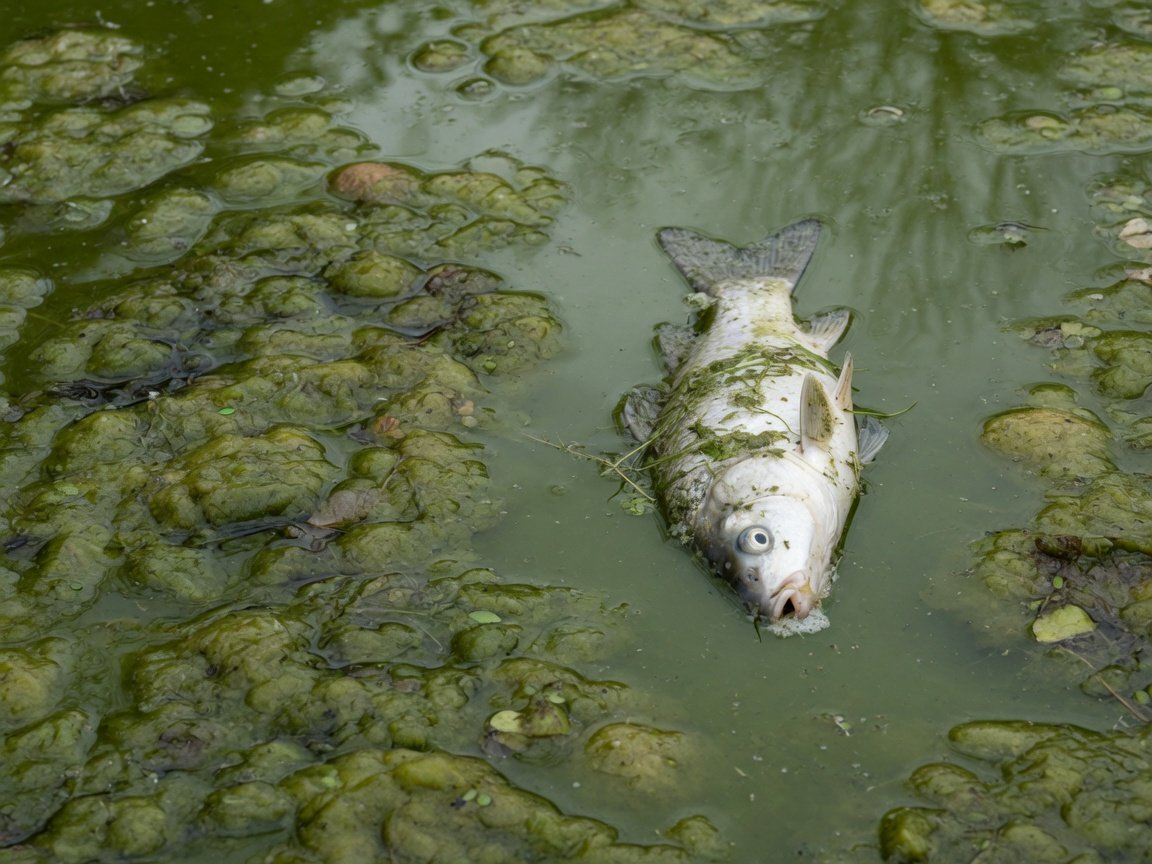
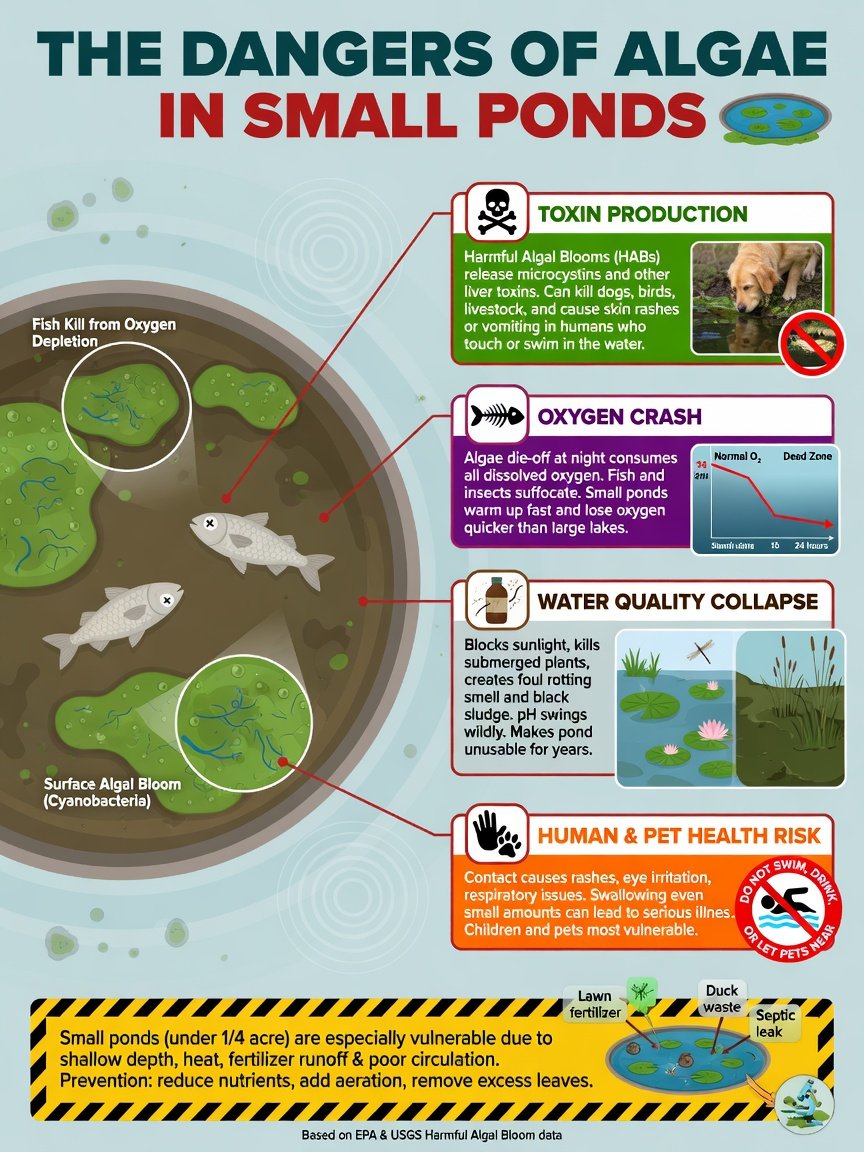
According to the UK Centre for Aquatic Plant Management, nuisance algae blooms can dramatically reduce dissolved oxygen levels — particularly overnight, when algae shifts from producing oxygen via photosynthesis to consuming it via respiration. In severe cases, this overnight oxygen crash can trigger fish kills before morning arrives.
The goal isn’t a sterile, algae-free pond. It’s balance. You want a thriving ecosystem where algae exists in manageable quantities — not an unchecked bloom that threatens everything living in your water.
Understanding this distinction shapes everything about how you approach treatment. Aggressive overkill rarely works and can introduce new problems. A methodical, fish-first approach consistently delivers better results.
What Are the Main Types of Pond Algae?
The type of algae you’re dealing with determines the most effective treatment. Using a UV clarifier on string algae, for example, won’t do a thing. Here’s a breakdown of the three main types pond owners encounter:
Green Water Algae (Planktonic Algae)
This is the classic pea-soup bloom — water so green and murky you can’t see your fish even a few inches down. It’s caused by billions of microscopic single-celled algae suspended in the water column. UV clarifiers are by far the most effective treatment for this type and can clear ponds in just one to two weeks without introducing any chemicals.
String Algae (Filamentous Algae)
These are the long, slimy green strands that attach to pond walls, rocks, plants, and pump intakes. String algae is tougher to eliminate than green water algae and requires a combination of manual removal and biological or targeted chemical treatment. UV clarifiers have no effect on it — the strands are too large to be disrupted by UV exposure.
Blue-Green Algae (Cyanobacteria)
Technically not algae at all, cyanobacteria can produce toxic blooms that are dangerous to fish, wildlife, pets, and humans. If you notice a blue-green scum on your pond’s surface with a musty or earthy odour — especially during warm weather — treat it as urgent. Keep pets and children away from the water and consider contacting a pond specialist or your local environment agency for guidance.
What Causes Algae Blooms in Your Pond?
Algae needs three things to thrive: sunlight, warm water, and nutrients. When your pond provides all three in abundance, algae will exploit every available resource. Freshwater ecology research consistently identifies phosphorus as the primary limiting nutrient in most freshwater algae blooms — meaning that reducing phosphorus loading in your pond delivers the biggest reduction in algae’s ability to grow.
The most common causes of algae blooms include:
- Overfeeding fish — Uneaten fish food breaks down into ammonia and phosphates, which are algae’s preferred fuel.
- Overstocked ponds — More fish produce more waste, which means more nutrients cycling through your water at all times.
- Lack of aquatic plants — Plants compete with algae for the same dissolved nutrients. Without them, algae wins the competition by default.
- Excessive sunlight — Ponds in full sun overheat and create ideal conditions for rapid algae photosynthesis and growth.
- Lawn and garden runoff — Fertilizers containing nitrogen and phosphorus wash directly into pond water during rain events.
- Decaying organic matter — Dead leaves, fish waste, and decomposing plant debris break down into nutrients that fuel future algae blooms.
How Do You Remove Pond Algae Manually?
Manual removal is your fastest route to immediate visual improvement, particularly for string algae and blanketweed. It won’t solve the underlying nutrient problem, but it significantly reduces algae load and gives your other treatments a head start. Think of it as clearing the decks so your biological and chemical tools can finish the job.
Follow these steps for effective manual algae removal:
- Use a pond rake, net, or algae brush to work through string algae in slow, sweeping motions. Start at the pond edges and work toward the centre.
- Twist algae onto the tool by rotating a rake handle or stick — this winds stringy algae around the shaft and makes bulk removal far more efficient.
- Remove pulled algae from the water immediately. Leaving it floating means it decomposes in your pond and releases nutrients straight back into the water column.
- Compost what you remove. Pond algae is an excellent garden fertilizer — bag it up and add it to your compost pile rather than sending it to landfill.
- Repeat weekly as maintenance. Manual removal works best as an ongoing habit rather than a single dramatic intervention.
One important caution: avoid vigorous vacuuming in a pond with fish. Disturbing decomposing sediment at the pond bottom can spike ammonia levels rapidly, stressing or killing fish within hours of the disturbance.
How Does Beneficial Bacteria Control Pond Algae?
Beneficial bacteria treatments are among the safest and most sustainable long-term solutions available for pond algae. These are live cultures of naturally occurring bacteria — the same species found in healthy, balanced ponds — that you introduce to your water to tip the biological competition in your favour.
Here’s the mechanism: algae feeds on ammonia, nitrates, and phosphates dissolved in your water. Beneficial bacteria consume those exact same nutrients as part of their own biological processes. When bacteria establish a healthy population, they out-compete algae for available nutrients, and algae growth slows dramatically as a result.
Pond management specialists consistently rank beneficial bacteria as a cornerstone of healthy pond maintenance — particularly in fish ponds where the risk profile of chemical treatments is inherently higher. Unlike algaecides, beneficial bacteria improve overall water quality across every parameter, not just algae suppression.
To get the most from beneficial bacteria treatments, keep these points in mind:
- Temperature matters — most bacteria products are most active above 50°F (10°C). Use cold-water formulations in early spring and late autumn when water temperatures drop.
- Dose regularly — bacterial populations need replenishing, especially after any chemical treatment that may reduce their numbers.
- Wait after algaecide use — give it at least 3–5 days for chemicals to dissipate before reintroducing live bacteria.
- Pair with aeration — beneficial bacteria are aerobic organisms. More oxygen in the water means faster nutrient breakdown and better long-term algae suppression.
Here’s a quick comparison of the most common algae control methods alongside their fish safety profile:
| Method | Effectiveness | Fish Safety | Time to Results |
|---|---|---|---|
| Manual Removal | Medium | Excellent | Immediate |
| Beneficial Bacteria | High | Excellent | 2–4 weeks |
| Aquatic Plants | High | Excellent | 4–8 weeks |
| UV Clarifier | Very High (green water only) | Excellent | 1–2 weeks |
| Barley Straw / Extract | Medium | Excellent | 4–6 weeks |
| Fish-Safe Algaecide | High | Good (with care) | 3–7 days |
Do Aquatic Plants Help Get Rid of Pond Algae?
Absolutely — and they’re one of the best long-term investments you can make for a healthy pond. Aquatic plants compete directly with algae for dissolved nutrients. They absorb the same nitrogen and phosphorus compounds that algae feeds on, starving it at the source before it can bloom.
Pond design specialists recommend achieving 50–70% surface coverage with aquatic plants for effective, sustained algae suppression. The shade created by floating plants also reduces sunlight penetration into the water column, directly slowing algae photosynthesis. It’s a double mechanism — nutrient competition and light reduction working simultaneously, around the clock.
The most effective plant types for algae control include:
Floating Plants
- Water hyacinth (Eichhornia crassipes) — one of the most aggressive nutrient absorbers you can put in a pond
- Water lettuce (Pistia stratiotes) — excellent shade provider with strong nutrient uptake capacity
- Duckweed — highly effective but can become invasive if not harvested regularly during the growing season
Submerged Oxygenating Plants
- Hornwort (Ceratophyllum demersum) — competes directly with algae for nutrients and releases oxygen, improving conditions for fish at the same time
- Waterweed (Elodea canadensis) — a robust oxygenator that thrives in most pond conditions and actively starves algae of nutrients
Marginal Plants
Iris, rushes, and cattails planted around the pond’s edges absorb nutrients from surface runoff before it can enter the water. They act as a living buffer zone — intercepting fertilizer and other nutrient sources at the perimeter so they never reach your pond in the first place.
Is a UV Clarifier Safe for Fish — and Does It Really Work?
A UV clarifier is one of the most reliable and completely fish-safe tools available for eliminating green water algae. The device passes your pond water through a chamber housing an ultraviolet bulb. The UV light damages the DNA of single-celled algae, causing individual cells to clump together. Your pond filter then captures those clumped cells before they can re-enter the water column.
UV clarifiers release no chemicals whatsoever into your water. They affect only organisms small enough to be suspended in the water column — meaning your fish, pond snails, established beneficial bacteria on your filter media, and any other resident pond life are completely unaffected by the process.
Pond equipment specialists frequently recommend pairing a UV clarifier with a high-quality biological filter for best overall results. The UV handles green water algae while the biological filter processes fish waste and ammonia. Together, they cover the two biggest water quality challenges in any fish pond.
Key points to know before buying a UV clarifier:
- UV clarifiers only work on planktonic algae — they have no effect on string algae, blanketweed, or blue-green algae mats.
- Flow rate is critical — water must pass through slowly enough for adequate UV exposure. Always match the clarifier’s rated capacity to your actual pond volume.
- Replace the bulb every year — UV output degrades over time even when the bulb still illuminates. A spent bulb provides little to no algae control.
- Allow 1–2 weeks for full visible results — the clarifier clumps dead algae cells progressively, so water clarity improves gradually rather than overnight.
Which Fish and Animals Eat Pond Algae Naturally?
Nature provides its own algae cleanup crew. Stocking your pond thoughtfully with algae-grazing species is one of the most enjoyable and sustainable approaches to long-term algae management — and it costs nothing once the right inhabitants are in place.
Grass Carp
Often called the “pond vacuum,” grass carp consume large quantities of aquatic vegetation, including soft algae. They’re highly effective but can be overzealous — they’ll eat desirable plants alongside algae. Grass carp require permits in many US states, so check your local regulations before stocking them.
Common Pleco
Plecos are excellent algae grazers in ornamental ponds and work particularly well in warmer climates. They cannot tolerate freezing water temperatures and must be moved indoors before winter in colder regions.
Koi and Goldfish
Koi and goldfish will graze on algae as a dietary supplement. However, they’re also significant nutrient producers — overstocked koi ponds are among the most algae-prone environments there are. Keep stocking levels appropriate for your pond volume to avoid defeating the purpose.
Pond Snails and Trapdoor Snails
Pond snails are underrated algae controllers. They graze constantly on the algae coating your pond walls and surfaces without affecting water chemistry in any way. Trapdoor snails are a particularly popular choice for this purpose in ornamental ponds.
Tadpoles
During their tadpole stage, frogs are voracious algae grazers. Encouraging frogs to breed in your pond — by creating shallow marginal areas and leaving some natural habitat along the edges — adds a free, self-renewing layer of algae control that costs you nothing at all.
Are Pond Algaecides Safe to Use Around Fish?
Algaecides can be used safely around fish — but only the right product, at the right dose, under the right conditions. Getting any of those variables wrong can be devastating for your pond life. Here’s what you need to know about the most common options:
Barley Straw Extract
Not technically an algaecide, barley straw works by releasing humic acids as it decomposes, which inhibit algae growth rather than killing existing algae outright. It is completely fish-safe and widely recommended by pond management specialists as both a treatment and a preventative measure. Physical straw bales take 4–6 weeks to activate; concentrated liquid extract acts significantly faster and is easier to dose accurately.
Copper-Based Algaecides
Copper-based products are effective but require extreme care. Copper is toxic to fish at elevated concentrations, and the margin between an algae-killing dose and a harmful fish dose can be uncomfortably narrow. The risk is amplified in soft water — low mineral content potentiates copper’s toxicity significantly. Always test water hardness before use and follow manufacturer dosing precisely, without rounding up.
Hydrogen Peroxide Treatments
Diluted hydrogen peroxide is increasingly popular for string algae and is considered relatively fish-safe when dosed correctly. H₂O₂ breaks down into water and oxygen, leaving no harmful residues in the pond. Apply it directly to affected algae patches rather than broadcasting it across the water, and dilute it appropriately before application to avoid direct contact burns.
Regardless of which algaecide you choose, these safety rules apply every single time:
- Treat in early morning when dissolved oxygen levels are at their daily peak
- Never treat during hot weather or heatwaves — low oxygen combined with algaecide is a recipe for rapid fish kills
- Never treat more than one-third of the pond surface at a time
- Run an aerator during treatment and for at least 24 hours afterward
- Monitor fish closely for signs of stress — gasping at the surface, lethargy, or erratic swimming — for a full 24 hours post-treatment
How Do You Stop Pond Algae From Coming Back?
Clearing algae once is satisfying. Keeping it gone requires a consistent maintenance routine that addresses root causes — not just visible symptoms. Here’s the long-term prevention plan that pond management specialists recommend for residential ponds:
- Manage your fish stocking level. The general guideline is 10 gallons of water per inch of fish. Overstocking is one of the fastest routes to chronic, recurring algae problems.
- Feed fish correctly. Only offer what fish can consume within 5 minutes and remove any uneaten food straight away. Overfeeding is a primary cause of nutrient buildup in residential ponds.
- Maintain your filter properly. A correctly sized biological filter keeps nutrient levels stable by processing fish waste efficiently. Clean filter media regularly, but never sterilize it — you’ll destroy the beneficial bacteria colony your water quality depends on.
- Add shade to your pond. If your pond receives more than 5–6 hours of direct sunlight daily, algae will consistently have the advantage. Floating plants, a pergola, or nearby shrubs and trees can all provide effective, natural shade cover.
- Manage garden runoff. Keep lawn fertilizers well away from pond edges and consider establishing a buffer zone of native grasses, sedges, or wildflowers to intercept nutrient-rich runoff before it reaches your water.
- Apply barley straw extract preventatively each spring. Used at low doses before algae season begins, it’s an excellent preventative tool — most effective when applied before algae establishes any foothold in the water.
- Test your water monthly. Regular testing for ammonia, nitrite, nitrate, and phosphate gives you early warning of nutrient buildup before algae can exploit it. Catching elevated levels early is far simpler than fighting an established bloom.
- Clear debris before winter. Autumn leaves and decomposing plant matter are a primary nutrient source for spring algae. Net your pond in autumn, remove organic debris before winter sets in, and you’ll start spring with cleaner water and far less fuel for the first algae bloom of the year.
Pond algae control isn’t about one heroic intervention. It’s about stacking multiple small advantages — clean water, healthy biology, the right plants, and consistent maintenance — until algae simply can’t compete with a well-managed ecosystem.
Frequently Asked Questions
Can I use bleach to kill pond algae without hurting my fish?
No — bleach (sodium hypochlorite) is highly toxic to fish and beneficial bacteria at even small concentrations. It will eliminate algae, but it will also kill your fish, destroy your biological filter, and potentially damage pond liners. Never use bleach in a pond containing fish. Safe alternatives include UV clarifiers, beneficial bacteria, barley straw extract, and purpose-formulated fish-safe algaecides.
How long does it take to get rid of pond algae?
It depends on the method. A UV clarifier typically clears green water algae within 1–2 weeks. Beneficial bacteria treatments show significant results in 2–4 weeks. Aquatic plants take 4–8 weeks to establish a competitive advantage over algae. If you combine methods — UV clarifier for green water, manual removal for string algae, and bacteria for long-term nutrient control — you’ll see the fastest overall improvement.
Why does my pond keep getting algae even after I treat it?
Recurring algae almost always means the underlying nutrient problem hasn’t been resolved. Treatments remove existing algae but don’t fix the conditions that created it. Check for overfeeding, overstocking, inadequate filtration, excessive sunlight, and runoff from nearby lawns or gardens. Address those root causes alongside your treatment, and you’ll break the cycle rather than just managing the symptoms.
Is green pond water harmful to fish?
Green water itself is generally not immediately harmful — in fact, the algae cells produce oxygen during daylight hours. The danger comes at night, when algae consumes oxygen instead of producing it. In a severe bloom, an overnight oxygen crash can cause fish stress or death before morning. This is why treating significant green water blooms promptly and running overnight aeration is important for fish welfare.
What is the fastest way to clear a green pond?
A properly sized UV clarifier is the fastest reliable method for clearing green water algae, typically delivering visible improvement within 3–5 days and full clarity within 1–2 weeks — with zero chemical input. For the fastest possible overall result, combine a UV clarifier with manual removal of any string algae and keep an aerator running to maintain safe oxygen levels throughout the process.
Does pond algae go away on its own?
Occasionally, algae blooms do subside naturally — typically when a seasonal nutrient pulse, such as spring runoff, is exhausted. However, in most residential ponds, the conditions that caused the bloom persist, and algae will return or continue growing. Waiting it out is rarely an effective strategy. Proactive management consistently delivers far more reliable, lasting results.
The Bottom Line: A Clear Pond Is a Healthy Pond
Getting rid of pond algae without killing fish isn’t complicated — it just requires choosing the right tools and understanding how your pond’s ecosystem actually works. Algae is a symptom, not the disease. The real issue is almost always excess nutrients meeting insufficient biological competition. Fix that, and you fix algae.
Here’s a clear action plan to get started:
- This week: Remove visible string algae manually and test your water for ammonia, nitrate, and phosphate levels to understand the scale of your nutrient problem.
- This month: Install a UV clarifier if green water is your primary issue, or begin beneficial bacteria dosing. Add your first round of aquatic plants.
- This season: Review your fish stocking levels and feeding habits. Improve shade coverage. Consider a planted buffer zone around your pond’s perimeter to intercept runoff.
- Ongoing: Test water monthly, maintain your filter, and apply barley straw extract each spring before algae season begins.
Your fish will thank you — and so will every frog, dragonfly, and pond snail that calls your water feature home.
— “`json
1 thought on “How to Get Rid of Pond Algae Without Killing Fish”