
The fastest answer to keeping leaves out of a fish pond: stretch a fine-mesh leaf net over the surface before the trees start shedding. Pair it with a surface skimmer and a pre-filter leaf trap on your pump, and you’ll intercept most debris before it ever sinks. Those three layers — physical barrier, surface collection, and mechanical filtration — form the backbone of every reliable leaf-management routine.
Some of the links in this article may be affiliate links. If you make a purchase through these links, we may earn a small commission at no extra cost to you. Thank you.
- A pond leaf net is the single most effective barrier during autumn leaf fall — and costs less than most remedial treatments.
- Surface skimmers catch leaves that blow in overnight or slip under the net’s edges, capturing up to 85–90% of floating debris before it sinks.
- Pre-filter leaf traps stop organic debris from reaching your pump impeller and biological filter media.
- Even a modest leaf build-up can trigger ammonia spikes toxic to koi and goldfish within two to three weeks.
- A quick daily check during peak leaf fall takes under five minutes and prevents hours of remedial maintenance.
Why Are Leaves in a Fish Pond Such a Serious Problem?
Leaves look harmless floating on the surface. In reality, a single mature deciduous tree can shed more than 200,000 leaves over the course of an autumn — and every one of them that reaches your pond starts a slow chemical chain reaction that your fish will eventually pay for.
Freshly fallen leaves float for a day or two before waterlogging and sinking to the pond floor. Once there, the organic matter begins decomposing. That process is driven by bacteria that consume dissolved oxygen as they break down leaf tissue. In a small or moderately stocked pond, oxygen levels can fall below the 5 mg/L threshold that koi and goldfish need to thrive — and in severe, untreated cases, approach the 2 mg/L level at which fish begin to suffocate. Pond care specialists consistently rank leaf management alongside filter maintenance and controlled feeding as one of the three pillars of healthy pond keeping throughout the colder months.
Tannins leaching from the leaves stain water a brownish tea colour and gradually lower the pH. A pH drop of even 0.5–1.0 units stresses fish, weakens their immune systems, and leaves them susceptible to bacterial infections and fungal outbreaks. The visible effect — brown, murky water — is only the surface symptom. The real danger is invisible until it shows up in a test kit reading or in the behaviour of your fish.
What Happens When Leaves Decompose in Your Pond?
The breakdown of leaves in pond water follows a predictable sequence, and understanding it explains why speed of removal matters. Within 24–48 hours of sinking, aerobic bacteria colonise the wet leaf surface and begin digesting the organic material. This first decomposition wave consumes dissolved oxygen rapidly. As oxygen depletes in the lower water column, anaerobic bacteria take over — and their by-products are far more dangerous than the leaves themselves.
Anaerobic decomposition releases hydrogen sulphide, the gas behind the rotten-egg smell in neglected ponds, and generates ammonia as nitrogen-containing leaf proteins break down. Ammonia becomes acutely toxic to koi and goldfish at concentrations above 0.5 mg/L. In a pond carrying significant leaf debris, that threshold can be reached within two to three weeks of heavy leaf fall — faster in warmer or smaller bodies of water.
There is also a delayed consequence that catches many pond keepers off guard. The decomposing leaves act as a nutrient bank for algae — releasing phosphates and nitrates into the water column throughout winter and early spring. Many pond owners who wrestle with a persistent algae problem in spring are actually dealing with the downstream chemistry of the previous autumn’s leaf build-up. Removing leaves promptly is one of the most effective spring algae prevention steps you can take.
“The sludge layer on the pond floor is the engine of autumn water quality problems. Most of it originates from leaves that were never removed.”
— Aquatic biology specialists note that bottom sludge is the primary driver of ammonia accumulation and hydrogen sulphide generation in autumn and winter ponds.
How Do Pond Leaf Nets Work — and Are They Worth It?
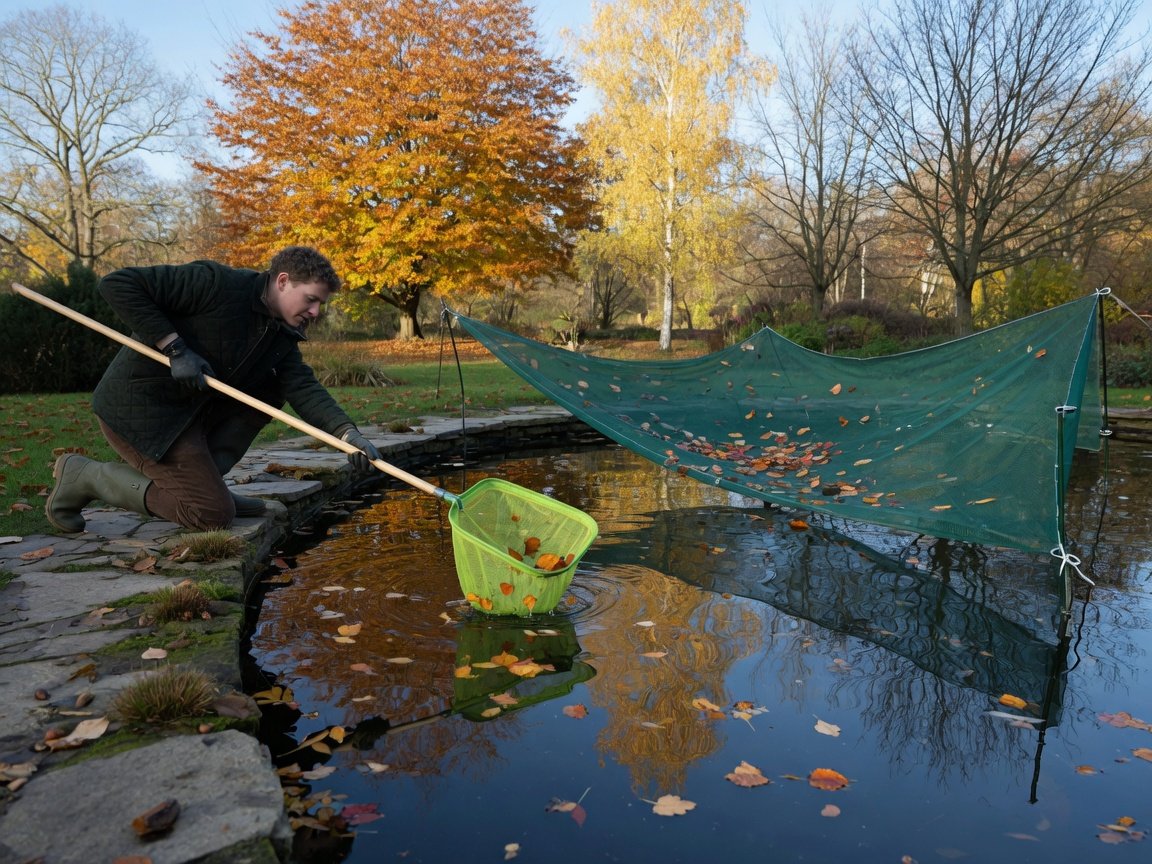
A pond leaf net is a fine-mesh net stretched over the water surface and secured at the pond edges. Leaves land on the net, dry out, and can be lifted away and composted in minutes. No leaves reach the water. No decomposition. No chemistry problems in November or February.
They are the most cost-effective leaf-management tool available — a good net for a small to medium pond costs a fraction of a single emergency water treatment product. Pond keepers who fit a net before the autumn season report cutting their leaf-management time by 50–70%, simply because they are not fishing out soggy debris or dealing with the water quality fallout. The investment pays for itself in the first season.
Getting the specification right matters. The mesh should be fine enough to catch small leaves from birch, willow, and cherry — varieties that shed tiny fragments capable of slipping through coarser netting — but open enough not to sag under the weight of wet leaves or restrict airflow over the surface. A 4–6 mm mesh typically hits the right balance. Crucially, the net should be elevated slightly above the waterline on stakes or a purpose-built support frame, so that wet leaves resting on the net never make contact with the water.
For a thorough breakdown of nets suited to different pond shapes and sizes — including mesh grades, anchor systems, and which designs also deter herons — the guide to the best pond nets for small ponds in 2026 covers the key options in detail.
Can a Pond Skimmer Really Keep Your Water Leaf-Free?
A pond skimmer works by drawing surface water — and everything floating on it — across a weir into a collection basket. The pump creates a continuous flow across the surface, pulling in leaves, pollen, and other floating material before it has a chance to waterlog and sink. Equipment manufacturers consistently cite surface debris capture rates of 85–90% for a correctly sized and positioned skimmer, which translates to a significant reduction in organic load reaching your filter and pond floor.
Sizing and placement determine whether a skimmer earns its keep. Skimmers are rated by the surface area they can effectively manage — an undersized unit on a large pond will miss most of what falls in. Position the skimmer intake on the downwind side of the pond: the breeze then pushes floating debris directly toward it, extending its effective range considerably. A skimmer installed on the upwind side fights the natural drift of surface material and captures far less.
Think of a skimmer as your second line of defence rather than your primary one. During the heaviest leaf fall days, no skimmer can keep pace with a continuous shower from an overhanging oak. But it handles reliably the leaves that blow in overnight, the material that slips under the net’s edges, and the general organic drift that accumulates between manual netting sessions. Combined with a leaf net, a skimmer gives you a genuinely low-maintenance autumn routine.
Should You Trim the Trees and Shrubs Around Your Pond?
If you’re planning a new pond or reworking the planting around an existing one, tree placement is worth serious thought. Trees positioned within five metres of a pond — particularly those with overhanging branches — are responsible for the majority of leaf fall problems. A single large beech, oak, or sweet chestnut upwind of your pond can shed leaves faster during peak autumn weeks than any net or skimmer can realistically manage.
For established gardens, full tree removal is rarely the right answer. Thinning the canopy by removing 20–30% of a tree’s crown meaningfully reduces autumn leaf volume without compromising the tree’s health or your garden’s character. Removing branches that extend directly over the water surface is more impactful still — these direct-drop branches contribute far more leaf matter per square metre than wind-carried leaves from trees set further back.
Marginal pond plants contribute to organic loading too, in a way that’s easy to overlook. Irises, rushes, and ornamental reeds die back in autumn and shed considerable organic matter directly into the shallow margins. Cutting these back to just above the waterline in late October takes twenty minutes and removes a significant source of debris before it has a chance to decompose on the pond floor over winter.
How Does a Leaf Trap or Pre-Filter Protect Your Pump?
Even with a net and skimmer running, some leaves always make it into the water. Those leaves eventually drift toward your pump intake — and this is where a leaf trap or pre-filter earns its place in the system. A leaf trap is a large-bore housing installed inline between the pond and the pump. Water and fine debris flow through freely, but whole leaves and larger organic fragments are caught in an internal basket or chamber.
Emptying a leaf trap takes under 30 seconds: lift the lid, pull out the basket, tip the contents into your compost, and clip it back in place. Do this every one to two weeks during autumn and you protect both the pump impeller from blockage and your biological filter from being smothered in organic material. A biological filter clogged with leaf fragments operates at a fraction of its rated capacity — the beneficial bacteria that convert ammonia into less harmful compounds simply cannot function when their media is buried under decomposing debris. Keeping leaves out of the filter is therefore as much about ammonia control as it is about preventing mechanical damage.
Is a Pond Vacuum the Best Tool for Settled Leaf Debris?
For leaves that have already sunk and begun breaking down into sludge on the pond floor, a pond vacuum is the most direct solution available. Pond vacuums draw debris from the floor into a collection chamber using suction, discharging clean water back into the pond. The physical removal of settled organic matter — rather than chemically treating the by-products of its decomposition — addresses the root cause rather than the symptom.
A single thorough vacuum session in early November — after the main leaf fall is over but before water temperatures drop consistently below 10°C — removes the majority of settled debris before it decomposes through the cold months. Aquatic biologists note that most of the ammonia accumulation in winter ponds originates not from new inputs but from the continued slow decomposition of organic material laid down in autumn. This one annual session can make a measurable difference to water quality readings in February and March.
Use the vacuum with a degree of restraint. The sludge layer contains beneficial micro-organisms that contribute to the pond’s biological balance, and removing all of it at once can temporarily destabilise the ecosystem. A targeted clean — removing the loose, soft surface layer of debris without disturbing compacted substrate — gives you the water quality benefit without the biological disruption.
How Often Should You Net Leaves Out by Hand?
Manual leaf removal — scooping leaves out with a fine-mesh pond net on a long handle — is the most accessible tool in the kit. No power required, no installation, works on any pond shape. The deciding variable is frequency. A leaf scooped out while it is still dry and floating on the surface takes seconds and releases nothing into the water. The same leaf left for 48 hours is waterlogged, fragile, and deposits tannins and particulates the moment it is disturbed.
During peak leaf fall — typically late September through to mid-November in the British Isles — a daily two-to-five minute surface skim removes the majority of fresh-fallen leaves before they waterlog. Outside of peak season, a twice-weekly check is usually sufficient. The table below compares the main leaf-removal methods across the factors that matter most to a typical pond keeper, giving you a clear picture of how they fit together.
| Method | Best For | Ongoing Effort | Upfront Cost | Effectiveness |
|---|---|---|---|---|
| Leaf Net | All pond sizes | Low — lift & shake weekly | Low | ★★★★★ |
| Surface Skimmer | Medium to large ponds | Low — empty basket weekly | Medium–High | ★★★★☆ |
| Leaf Trap / Pre-filter | Pump and filter protection | Very low — empty fortnightly | Low–Medium | ★★★★☆ |
| Pond Vacuum | Settled floor debris | Seasonal — 1–2× per year | Medium | ★★★★☆ |
| Manual Hand Net | Any size, on demand | High — daily during autumn | Very Low | ★★★☆☆ |
| Tree / shrub trimming | Reducing leaf source | Annual | Variable | ★★★★☆ |
What’s the Best Autumn Routine for a Healthy Pond?
The most effective approach combines all the methods above into a simple layered routine. Prevention (the net), interception (skimmer and leaf trap), and clean-up (manual netting and the annual vacuum) work together — each catches what the previous layer misses. Here’s how to roll that into a practical schedule across the September to November window.
- Early September: Fit the leaf net before the first leaves fall. It takes 20 minutes once and eliminates hours of reactive work. Support it above the waterline on stakes.
- Weekly: Lift the leaf net and shake or roll accumulated leaves onto the compost. Check the skimmer basket and empty if needed.
- Every two weeks: Open the leaf trap housing, rinse out the basket, and refit. Takes under one minute.
- Daily (peak leaf fall, October–November): Two to five minutes with a hand net each morning catches anything that has slipped through overnight.
- Late October: Cut back marginal plants — irises, rushes, reeds — to just above the waterline. Dispose of the cuttings away from the pond.
- Early November: Run the pond vacuum over the floor once the bulk of leaf fall is done. Remove accumulated sludge before it degrades water quality through winter.
- November onwards: Shift focus to winter preparation. Ensure the pump keeps running, monitor water temperature, and consult the advice on keeping pond fish safe as temperatures fall toward freezing — the quality of your autumn leaf management directly affects how well your fish come through the coldest months.
How Do You Monitor Water Quality After a Heavy Leaf Fall?
Even the most diligent routine cannot intercept every leaf, and some decomposition is inevitable. Water quality testing is therefore an essential part of autumn pond keeping — not an optional extra. The parameters that matter most after a heavy leaf fall are ammonia, nitrite, pH, and dissolved oxygen.
Ammonia is the most urgent indicator. Any reading above 0.25 mg/L in a fish pond warrants attention. A reading above 0.5 mg/L is a fish emergency requiring immediate action — a 20–25% partial water change combined with temporarily stopping feeding will usually bring levels back into a safe range within 24–48 hours. Nitrite matters too: it spikes when the biological filter is overwhelmed by organic load, which is exactly what happens when large quantities of leaves enter the system. pH tells you about cumulative tannin load — a pH reading below 7.0 suggests the leaves are beginning to affect the water chemistry, and buffering may be needed.
A typical scenario the team at The Pondineer regularly hears about: a pond keeper returns from two weeks away in mid-October to find their small koi pond covered in fallen leaves. Their fish are gasping near the surface — a clear sign of oxygen depletion — and ammonia tests at 0.8 mg/L. An emergency partial water change, removal of all surface and settled debris, and a 72-hour feeding pause bring the ammonia back below 0.25 mg/L within four days. The lesson those pond keepers consistently take away: a £15 leaf net and a daily five-minute check would have prevented the entire episode.
Test your water at least once a week throughout September to November. After a storm or a sudden cold snap that accelerates leaf drop, test within 24 hours. Early detection means a simple water change rather than a crisis intervention. A good multi-parameter test kit covering ammonia, nitrite, nitrate, and pH is the minimum toolkit — for a comparison of the most reliable options, the guide to the best test kits for pond water covers what to look for at each price point.

Frequently Asked Questions
How do I stop leaves from getting into my fish pond?
The most reliable method is to fit a fine-mesh pond leaf net over the surface before leaf fall begins in early September. Support it on stakes so it sits above the waterline, empty it weekly, and combine it with a surface skimmer to catch what slips in at the edges. This two-layer approach intercepts the overwhelming majority of autumn leaf fall before it can reach the water.
Are leaves in a fish pond dangerous?
Yes — decomposing leaves are one of the most common causes of fish health problems in autumn. They deplete dissolved oxygen, raise ammonia levels to toxic concentrations (above 0.5 mg/L for koi and goldfish), lower pH through tannin release, and contribute to hydrogen sulphide production in bottom sludge. The visible sign — brown, murky water — is only the surface of a deeper chemical problem.
How often should I remove leaves from my pond?
During peak leaf fall in October and November, aim for a daily hand-net skim to catch fresh-fallen leaves before they sink. If you are using a leaf net, empty it at least once a week — more often after high winds. Leaves can waterlog and sink within 24–48 hours, so frequency matters considerably more than technique.
Do pond skimmers remove all leaves?
No. A well-sized skimmer is very effective at capturing floating debris before it sinks, but it cannot keep pace with a heavy leaf fall event or recover leaves that have already become waterlogged. Think of it as your second line of defence. The primary barrier should be a physical leaf net — together they handle the great majority of leaf input with minimal manual intervention.
What should I do if leaves have already sunk into my pond?
Remove settled leaves immediately using a pond vacuum or fine-mesh long-handled net. Test your water for ammonia and pH straight away. If ammonia is elevated above 0.25 mg/L, carry out a 20–25% partial water change and stop feeding until levels return to normal. Then fit a leaf net to prevent further accumulation.
Does a leaf net hurt my fish or restrict oxygen exchange?
No — a correctly fitted leaf net elevated above the water surface on stakes does not restrict oxygen exchange at all. The open mesh allows free air circulation over the water. The risk only arises if the net sags directly onto the surface when laden with wet leaves, which is exactly why the support system matters. Fish habituate quickly to a properly installed net and show no signs of stress.
The Bottom Line: Autumn Leaf Management Is the Investment Worth Making Every Year
Keeping leaves out of your fish pond is not complicated — but it does require consistent effort across a roughly eight-week window each autumn. The good news is that the tools are affordable, the daily tasks are quick once you are set up, and the returns are substantial: healthier fish, cleaner water, fewer spring algae problems, and less remedial maintenance through winter.
The non-negotiables are a leaf net, a surface skimmer, and regular hand-netting during peak fall. Add a pre-filter leaf trap to protect your pump, run the pond vacuum once the bulk of leaves have fallen, and keep a water test kit to hand so you can catch any ammonia or pH shifts before they become a fish health crisis.
Leaf management is also the foundation for a safe winter. The water quality you carry into November directly shapes how well your fish come through the cold months — and the steps you take with leaves in September and October are some of the most cost-effective things you can do for your fish’s long-term health. For a fuller picture of year-round water quality management, the stormwater pond maintenance guide covers the complementary practices worth building into your routine alongside seasonal leaf control.
Start before the first leaves fall. Get the net up in early September. Everything else follows naturally from there.