
Koi fish can cost anywhere from $5 for a small feeder-grade fish to over $1.8 million for a championship Japanese specimen — and the gap between those numbers comes down to a handful of very specific factors. Whether you’re budgeting for your first pond or trying to understand what your existing fish are actually worth, this guide breaks down every price driver, every price tier, and how to tell good value from an overpriced pond fish.
Some of the links in this article may be affiliate links. If you make a purchase through these links, we may earn a small commission at no extra cost to you. Thank you.
Key takeaways:
- Pet-store koi typically cost $5–$50; specialist breeder fish range from $200 to $5,000+
- Show-quality Japanese koi regularly sell at auction for $10,000–$50,000 or more
- The four biggest price drivers are size, colour pattern, body shape, and bloodline
- Ongoing costs — pond setup, food, filtration — often exceed the fish’s purchase price within the first year
What Does a Koi Fish Actually Cost? A Price Chart by Grade
There isn’t one koi market — there are several, and the fish swimming in a plastic bag at your local pet shop and the koi auctioned in Niigata, Japan are barely comparable despite being the same species. Understanding where different fish sit on that spectrum is the first step to shopping smart.
| Grade | Typical Source | Price Range | What You Get |
|---|---|---|---|
| Feeder / Pond Grade | Pet stores, garden centres | $5–$50 | Small fish, mixed colouring, unknown lineage |
| Select Pond Grade | Local koi dealers | $50–$200 | Better colour, some pattern definition |
| Mid-Grade | Specialist koi dealers | $200–$2,000 | Strong colour, good body shape, known variety |
| High-Grade (Domestic) | Reputable breeders | $2,000–$10,000 | Excellent conformation, verified lineage |
| Show-Grade (Japanese) | Japanese breeders / auctions | $10,000–$50,000+ | Championship bloodlines, competition-ready |
| Champion / Record | Top Japanese auction houses | $50,000–$1,800,000+ | The absolute pinnacle of the hobby |
Most backyard pond owners spend between $50 and $500 per fish — the sweet spot for attractive, healthy koi with decent colour and body shape. If you’re still setting up your first pond, starting in the $20–$100 range while you learn water management is completely sensible. You can always add higher-grade fish as your confidence grows.
What Factors Determine How Much a Koi Fish Is Worth?
Koi pricing isn’t arbitrary. There’s a clear hierarchy of quality signals that breeders, judges, and serious collectors use to assess a fish — and understanding those signals helps you determine whether a price tag is fair or inflated.
Size
Bigger almost always means worth more in the koi market. Larger fish cost more to raise — they require more pond space, more food, and more years of careful management to reach their size. A jumbo koi measuring 24 inches or more can command $500–$15,000 depending on its other qualities. A five-inch baby koi of the same variety might cost $20. The value jump isn’t linear — it accelerates sharply as fish reach impressive sizes.
Colour and Pattern
Colour is typically the first thing buyers notice and one of the most important quality indicators in show settings. Judges look for vivid, well-defined colours with crisp transitions between pattern areas. A Kohaku (white body with red markings) should have bright, saturated red — called “hi” — that doesn’t bleed into the white. Pattern balance matters too: a fish with colour evenly distributed from head to tail scores significantly higher than one with all its markings clustered at one end.
Body Shape and Conformation
An experienced koi keeper can assess quality from across the pond. The ideal body is torpedo-shaped: broad across the shoulders, tapering smoothly toward the tail, with no spinal curves or asymmetrical fins. A fish that looks pinched behind the head or has an uneven body line is likely to stay that way — and its price should reflect that. Body conformation also predicts growth: well-shaped young fish tend to reach impressive adult sizes; poorly shaped ones rarely do.
Bloodline and Lineage
Japanese koi breeders have spent over 200 years refining specific bloodlines to consistently produce fish with desirable traits. A koi from a well-documented lineage — particularly from top Niigata farms like Dainichi, Sakai Fish Farm, or Izumiya — carries a premium because its genetic future is more predictable. These fish are far more likely to develop into quality adults than fish with unknown parentage. For a thorough breakdown of everything that affects what a koi is worth, this guide to koi value factors is worth reading before you make a significant purchase.
Age
Young koi — called tosai at under one year old — are cheapest but riskiest. You’re buying potential, not certainty. A baby koi’s adult colour and pattern can look completely different from its juvenile appearance. Nisai (two-year-old) koi cost more but give a much clearer picture of how the fish is developing. A well-grown nisai from a quality farm can be worth three to ten times its tosai price. Established adults with proven colour stability are the most expensive — and the least risky — purchases of all.
A quality koi from a strong bloodline can increase in value by 20–50% per year during its first five growing seasons — provided it’s maintained in excellent conditions and developing well.
Pet Store vs. Breeder vs. Auction: Where You Buy Changes the Value Equation
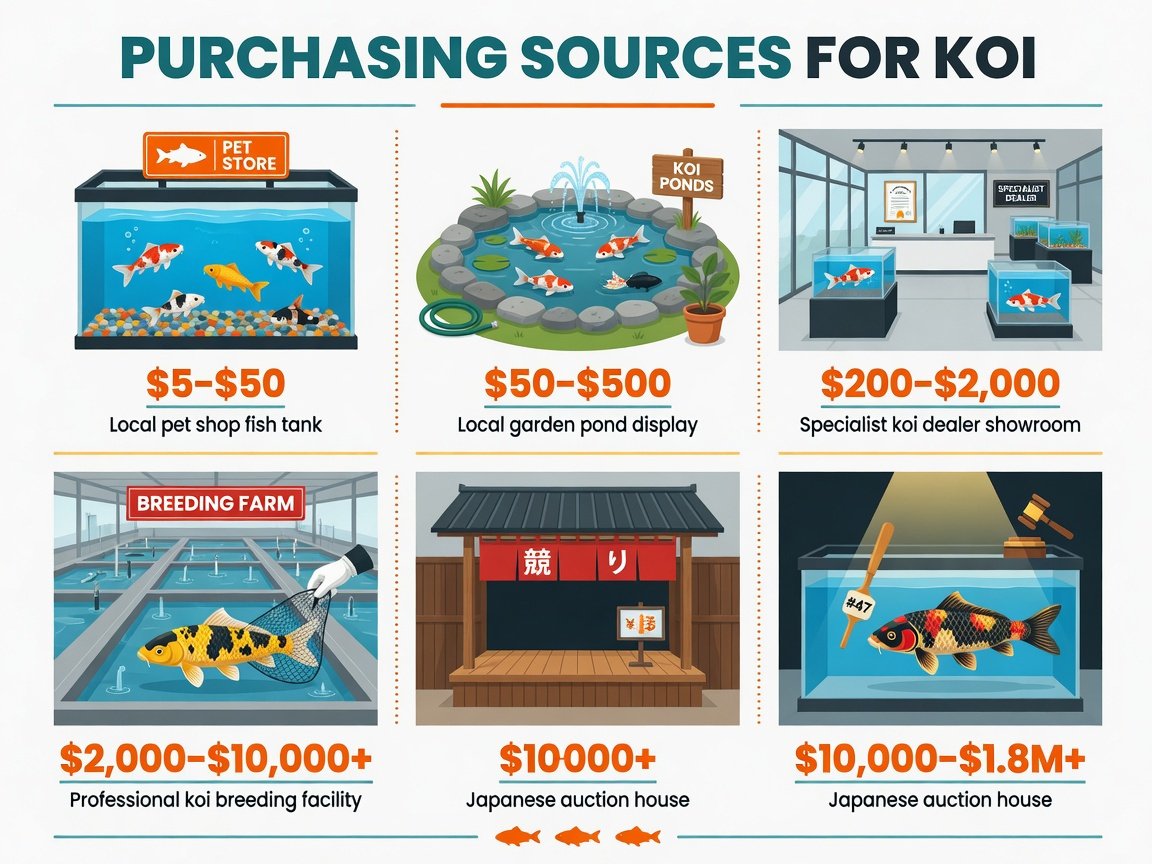
Two koi with identical-looking price tags from different sources can be entirely different propositions. Here’s how the main purchasing channels stack up:
| Source | Typical Price | Pros | Cons |
|---|---|---|---|
| Pet Store / Garden Centre | $5–$50 | Easy to access, low financial risk, good for beginners | Unknown lineage, variable quality, limited variety |
| Local Koi Dealer | $50–$500 | Can inspect in person, some variety selection | Quality varies widely between dealers |
| Specialist Koi Breeder | $200–$10,000+ | Known lineage, quality guidance, expert support | Higher upfront cost; waiting lists for top fish |
| Online Koi Retailers | $20–$5,000 | Wide selection, often 20–40% cheaper than in-store | Can’t inspect before buying; shipping adds $50–$200 |
| Japanese Breeders / Auctions | $1,000–$1,800,000+ | The world’s finest fish, now accessible via live-stream | Import costs, quarantine requirements, very high minimum spend |
For most pond owners, a reputable local koi dealer or specialist online retailer hits the right balance between quality and value. You get to see — or see detailed photos of — the specific fish you’re buying, some assurance of quality, and fair pricing without the markups that come with the very top tier. For any fish above $500, always ask about lineage. For fish above $1,000, ask for documentation.
What Are the Most Expensive Koi Fish Ever Sold?
The record for the most expensive koi ever sold belongs to a Kohaku named S Legend, purchased at the 2018 All Japan Koi Show for approximately $1.8 million USD (¥202 million). S Legend was a female Kohaku bred by the legendary Sakai Fish Farm in Hiroshima, and she was considered near-perfect by the judging panel across every quality metric: body shape, hi (red) intensity, pattern balance, and overall visual impression. She wasn’t just a beautiful fish — she represented the cumulative output of more than two centuries of expert breeding.
High-value koi sales aren’t limited to once-in-a-generation records. At Japan’s major annual shows and auctions, champion-grade Kohaku, Sanke, and Showa regularly sell for $50,000–$200,000+, and serious collectors travel from the UK, US, Europe, and Southeast Asia specifically to bid. Expert koi judges can assess a nisai (two-year-old) fish and make confident predictions about how it will look at five or six years old — and that predictive expertise is a significant driver of the high prices paid for young show-potential fish.
For the most extraordinary koi fact of all: the oldest known koi was a scarlet fish named Hanako, documented as having lived in Japan to 226 years old, dying in 1977. Her age was verified through growth-ring analysis of her scales. It’s a reminder that when koi enthusiasts talk about a long-term commitment, they mean it quite literally.
Which Koi Varieties Are Worth the Most Money?
The koi world spans an extraordinary range of recognised varieties, but in terms of market value, a handful dominate the upper tier. The variety you choose affects not just what you’ll pay today, but what the fish might be worth as it develops.
- Kohaku — White body with red markings. The most iconic koi variety and consistently among the most valued at international shows. Quality Kohaku range from $200 to $50,000+.
- Taisho Sanke (Sanke) — White base with red and black markings. One of the “Big Three” alongside Kohaku and Showa. Show-grade Sanke: $300–$30,000+.
- Showa Sanshoku (Showa) — Black base with red and white markings. Prized for dramatic colouring and bold pattern interplay. Quality Showa: $400–$40,000+.
- Tancho — Any variety featuring a single circular red spot on the head. A symmetrical, perfectly proportioned Tancho mark is genuinely rare and commands a premium of 30–60% over standard specimens of the same variety.
- Ogon — Solid metallic gold or silver. Simpler than patterned varieties but visually striking. Quality Ogon: $50–$800.
- Butterfly Koi (long-fin) — Long, flowing fins that move dramatically in water. Typically 10–30% more expensive than standard-fin equivalents at the same quality level.
- Utsurimono — Black-based koi with bold contrasting white, red, or yellow markings. Dramatic and deeply sought after — Utsurimono koi have a particularly devoted collector following thanks to their striking two-tone contrast and powerful visual impact.
How Does a Koi’s Size Affect Its Price?
Size and price are closely correlated in the koi market. Larger fish cost more to produce — they need more time, more food, and more pond space to reach their size — and a koi’s size is itself a proxy for genetic quality and consistent, expert care. Here’s how price typically scales with size:
| Size | Classification | Typical Age | Approximate Price Range |
|---|---|---|---|
| Under 6 inches | Tosai (juvenile) | Under 1 year | $5–$100 |
| 6–12 inches | Nisai (young adult) | 1–2 years | $50–$500 |
| 12–18 inches | Sub-adult | 2–4 years | $200–$3,000 |
| 18–24 inches | Adult | 4–7 years | $500–$10,000+ |
| 24+ inches | Jumbo | 7+ years | $1,000–$50,000+ |
Growth rate is heavily influenced by pond conditions — water temperature, quality, stocking density, and feeding all play a role. Understanding how large koi can actually grow helps set realistic expectations for your fish and explains why truly jumbo specimens command the prices they do. A koi reaching 30 inches or more has typically been expertly managed for well over a decade.
What Are the Ongoing Costs of Keeping Koi?
Here’s something that catches a lot of new koi keepers by surprise: the purchase price of the fish is often the smallest part of the total investment. The infrastructure and ongoing care required to keep koi healthy — and to protect the money you’ve spent on them — adds up quickly. Before spending $200 on a fish, make sure you understand what you’re actually committing to.
- Pond installation: $2,500–$15,000+ depending on size, liner type, and filtration. A basic DIY setup can be done for less, but a system genuinely capable of supporting quality koi will sit at the higher end.
- Filtration system: $200–$2,000+ upfront; $50–$200 per year in replacement media and consumables.
- Food: $200–$800 per year for a well-stocked pond. Quality pellets with the right protein-to-fat ratios make a measurable difference to growth rates and colour development.
- Water testing and treatments: $50–$150 per year for DIY testing kits and basic water treatments to keep parameters stable.
- Professional pond servicing: $500–$3,000 per year if you bring in outside help for seasonal maintenance.
- Health care: Treatment for disease or parasites can cost $100–$500+ per incident. Learning how to prevent common conditions like fin rot before they take hold will save you real money year over year.
Getting your pond environment right before you add expensive fish is the smartest investment you can make. The number of koi your pond can safely support directly affects water quality and fish health — understanding your pond’s true koi capacity before stocking it prevents the costly water quality problems that kill expensive fish.
How Can You Tell If a Koi Fish Is Good Value?
Assessing whether a koi is worth its price tag is a learnable skill. Run through this checklist before you hand over money:
- Watch how it swims. A healthy koi moves smoothly and purposefully. Erratic movement, listing to one side, or clamped fins are health red flags — don’t pay good money for a fish that’s already struggling.
- Evaluate the body shape. Look for a broad, well-proportioned torpedo shape. A fish that looks pinched behind the head or has a curved spine is likely to stay that way.
- Assess the colour. Colours should be vivid and well-defined. Faded or patchy colour on a fish marketed as high-grade is a warning sign — though some colour does develop with age in very young tosai fish.
- Check the fins. Fins should be fully spread, undamaged, and free of white fringing or holes. Ragged fin edges can indicate disease or poor water quality in the seller’s system.
- Ask about lineage and age. A reputable seller should be able to tell you the variety, approximate age, and ideally the farm or breeder. For any fish above $500, ask for paperwork.
- Compare to the price benchmarks in this guide. If a fish is priced significantly above what its apparent grade would suggest, ask the seller to explain the premium. Sometimes there’s a genuine reason — sometimes there isn’t.
Koi keeping is a long-term commitment — these fish can live 25–35 years under proper care, and the right fish in the right pond keeps developing and improving over time. Patience and due diligence at the point of purchase pay dividends across many years of ownership.
What Koi Market Trends Should Buyers Watch in 2026?
The koi market continues to evolve, and 2026 brings a handful of trends that affect both what you’ll pay and where the best fish can be found.
Online live-stream auctions are now mainstream. Japanese farm auctions once accessible only to those who could travel to Niigata are now available via live-stream to international buyers. Collectors in the UK, US, and Australia can bid directly at major farm events. This has opened access to quality fish at competitive prices — but it also means more global competition for the best specimens, pushing prices upward at the top end.
Currency dynamics are affecting import prices. The relative value of the yen against the pound and dollar has fluctuated significantly in 2024–2026. When the yen is weak, Japanese-origin koi — and fish from importers who source from Japan — become more affordable for international buyers. Tracking exchange rates before a significant Japanese koi purchase can represent meaningful savings on a $5,000–$20,000 fish.
Newer varieties are gaining serious collector interest. Kikokuryu (metallic Kumonryu), Shiro Utsuri, and Doitsu variants have seen growing demand from younger enthusiasts drawn to bold, graphic patterns. This is gradually pushing prices up for quality examples of these varieties, while Kohaku, Sanke, and Showa remain the benchmark at the championship level.
The tategoi approach is spreading beyond Japan. Tategoi — buying young fish for their future potential rather than current appearance — has traditionally been a Japanese breeder practice. Western collectors are increasingly adopting it, purchasing quality nisai fish and growing them out over three to five years. The financial upside can be substantial if the fish develops well, but it requires a well-managed pond environment and genuine patience.
Frequently Asked Questions About Koi Fish Prices
How much does a koi fish cost for a beginner?
Most beginners do well starting in the $10–$100 range per fish. You can find attractive, healthy koi in the $20–$50 bracket at local koi dealers that will thrive in a well-maintained pond. Starting with mid-range fish while you develop your water management skills makes sense — you can move up to higher-grade fish once your pond is running well and you understand what to look for.
Why are some koi fish so expensive?
High-end koi represent the cumulative output of centuries of selective breeding, years of expert care, and a set of visual qualities — colour intensity, pattern balance, body conformation — that are genuinely rare at the highest levels. The top fish also carry commercial value as breeding stock, which pushes prices further. It’s comparable to buying a champion thoroughbred rather than a paddock horse: genetics, provenance, and proven performance all compound into the final price.
Do koi fish increase in value over time?
Quality koi from strong bloodlines can appreciate significantly as they grow and develop. A well-managed nisai from a reputable farm can be worth three to five times its purchase price by the time it’s five years old and its colour has fully emerged. That said, koi keeping isn’t a reliable investment vehicle — disease, pond accidents, and colour that doesn’t develop as hoped are real risks. Buy fish you’ll genuinely enjoy in your pond regardless of their resale value.
What is the cheapest type of koi to buy?
Ghost koi (a cross between wild carp and metallic koi) and standard pond-mix koi are the most affordable, typically $5–$20 at pet stores and garden centres. Ogon (solid metallic gold or silver) koi also sit at the affordable end of the specialist market. These fish can be genuinely beautiful and completely satisfying in a backyard pond — not everything needs to come from a Japanese championship bloodline.
Is a $500 koi worth it compared to a $50 koi?
Often, yes — but it depends on what you want. A $500 koi from a reputable breeder typically has better colour, better body shape, and a documented lineage, making it more likely to grow into an impressive adult. A $50 fish from a garden centre might be perfectly pleasant but comes with no guarantees about how it will develop. If you care about how your pond looks in five years, the higher spend usually pays off. If you’re still learning, start cheaper and upgrade once you’re ready.
How much does the most expensive koi fish cost?
The record belongs to “S Legend,” a Kohaku female bred by Sakai Fish Farm, sold for approximately $1.8 million USD at the 2018 All Japan Koi Show. This remains the highest documented price for a single koi. Champion-grade fish regularly sell for $50,000–$200,000+ at major Japanese shows, and exceptional examples at international events in the UK and Europe frequently achieve $10,000–$80,000.
The Bottom Line: What Are Your Koi Actually Worth?
Koi are worth exactly what the market says they are — and that range is as wide as almost any pet market in the world. A $10 fish from a pet shop and a $10,000 fish from a Niigata breeder are both koi, but they’re aimed at entirely different buyers with different goals.
For most pond owners, the $50–$500 per fish range hits the right balance: fish that are genuinely attractive, grow well under decent care, and reward you over many years of ownership without requiring a competition-grade budget. As your pond develops and your eye sharpens, you can step up the quality — and the price — knowing exactly what you’re getting and why.
Whatever you choose to spend on the fish themselves, prioritise the pond infrastructure first. A high-quality koi in a poorly managed pond won’t stay high quality for long. Get the water right, nail the filtration, stock at a sensible density, and then add the fish that genuinely excite you. The rest takes care of itself.
—