
A pond aeration system is the single best upgrade you can make to your pond. It raises dissolved oxygen, reduces algae, breaks down organic waste, and keeps fish thriving — all at the same time. The right aerator transforms murky, smelly water into a clear, healthy ecosystem you’ll actually enjoy year-round.
Some of the links in this article may be affiliate links. If you make a purchase through these links, we may earn a small commission at no extra cost to you. Thank you.
Key Takeaways
- Dissolved oxygen below 5 mg/L stresses fish, slows beneficial bacteria, and triggers algae blooms — aeration keeps levels consistently in the safe range.
- Depth decides the system: fountain aerators work best in ponds up to 6 feet deep; bottom diffuser systems are the right choice for anything deeper.
- Centre-pond placement is essential — positioning an aerator at the edge creates oxygen dead zones across the far side of the pond.
- Run stocked fish ponds continuously, 24 hours a day — oxygen demand doesn’t pause at night, and night-time levels are typically the lowest of the day.
What Is a Pond Aeration System and Why Does Your Pond Need One?
A pond aeration system introduces oxygen into the water and promotes circulation throughout the water column. That sounds simple, but the effects reach into every aspect of your pond’s health.
Left to itself, a still pond stratifies. Warm, lighter water sits on top. Cooler, denser, oxygen-depleted water settles at the bottom. Beneficial bacteria — the microorganisms that break down fish waste and decaying plant matter — are aerobic organisms: they need oxygen to function. When bottom oxygen drops, they slow down or die off. Ammonia and other toxins accumulate. The water clouds, smells bad, and becomes hostile to fish.
Thermal stratification also harms fish directly. In warm weather, fish get trapped in a shrinking band of breathable water near the surface. In winter, ice cover can seal the pond entirely — cutting off gas exchange and triggering winterkill, a rapid fish die-off from oxygen depletion and toxic gas buildup that can occur within just a few days. Aeration disrupts stratification, mixes the water column, and keeps oxygen levels consistent from surface to floor, year-round.
What Are the Real Benefits of Installing a Pond Aeration System?
The headline benefit is more oxygen — but the downstream effects are what make aeration such a worthwhile investment. Here is what actually changes when you install a well-matched system.
- Fewer algae blooms. Algae thrives in nutrient-rich, stagnant water. Aeration disrupts the still, warm surface conditions algae needs to dominate, and it supports the biological activity that removes the excess nitrogen and phosphorus algae feeds on. If algae is already established in your pond, pairing aeration with targeted treatment often delivers faster results. This head-to-head comparison of algae treatments by type is a useful companion to this guide.
- Elimination of toxic gases. Hydrogen sulphide and excess carbon dioxide accumulate in stagnant bottom water. Aeration pushes these gases to the surface where they off-gas harmlessly into the atmosphere. The unpleasant sulphur smell disappears. Fish stop surfacing to gasp.
- Faster organic breakdown. Aerobic bacteria decompose fish waste, uneaten food, and leaf debris far more efficiently than anaerobic bacteria — and without producing harmful byproducts. More oxygen means more aerobic activity, less sediment buildup, and cleaner water.
- Improved water clarity. Circulating, oxygenated water encourages tiny suspended particles to clump together through a process called flocculation, making them easier for your filter to remove. Clarity typically improves noticeably within two to four weeks of installing a correctly sized system.
- Healthier, more vibrant fish. Consistent oxygen levels reduce chronic stress, support stronger immune responses, and allow natural colour pigmentation to express more brightly. Dull, lethargic fish are often a symptom of chronically low dissolved oxygen rather than disease.
What Types of Pond Aeration Systems Are Available?
Three main technologies cover the vast majority of garden and ornamental pond applications. Understanding how each one works makes it straightforward to match the right system to your pond.
Fountain Aerators
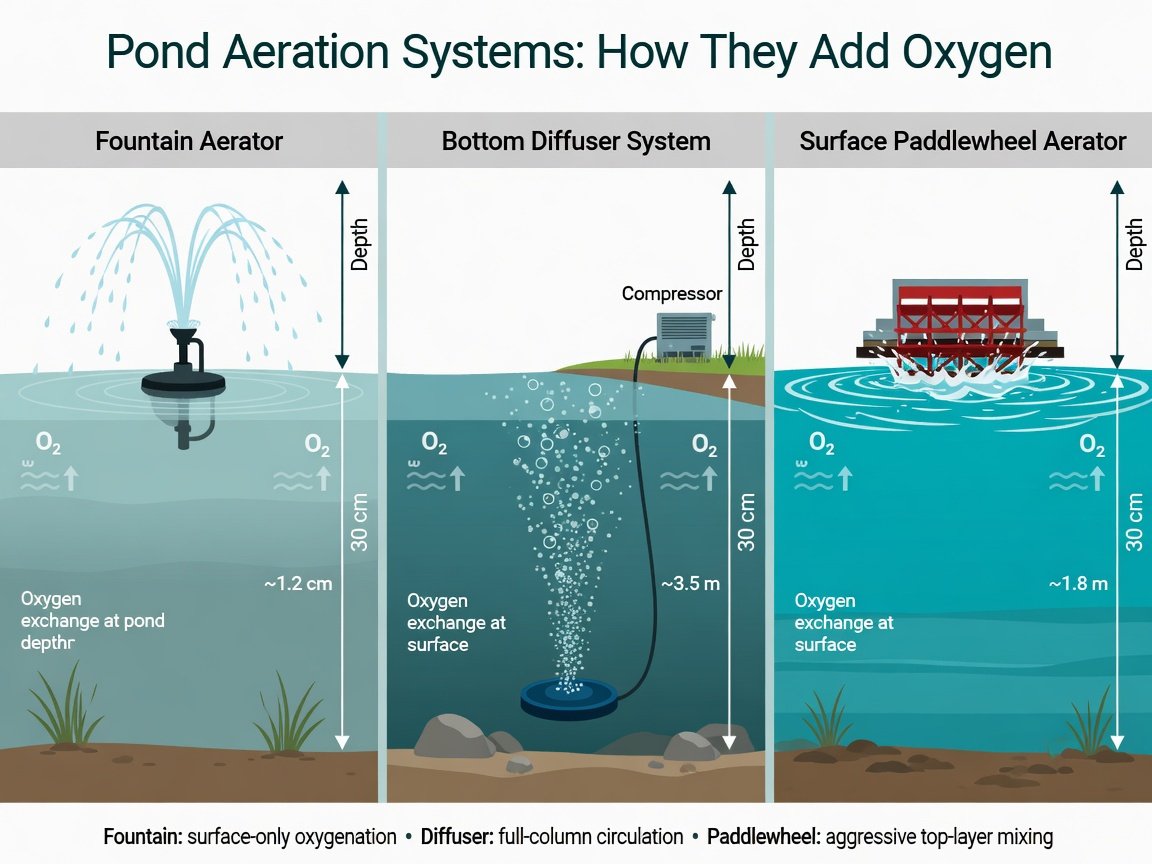
Fountain aerators draw water from the surface layer and spray it into the air through a nozzle or diffuser head. As the droplets fall, they absorb oxygen and land back in the pond enriched. The surface agitation itself also promotes gas exchange at the water–air interface, adding a second layer of oxygenation beyond the spray.
Fountain aerators work best in ponds no deeper than 6 feet. Because they draw from and return water to the upper layer, they don’t oxygenate deeper water effectively. For shallow garden ponds and decorative features, they’re an excellent choice — affordable, visually appealing, and effective within their depth range. A well-chosen spray pattern also adds movement, sound, and life to what would otherwise be a static water surface.
Bottom Diffuser Systems (Subsurface Aeration)
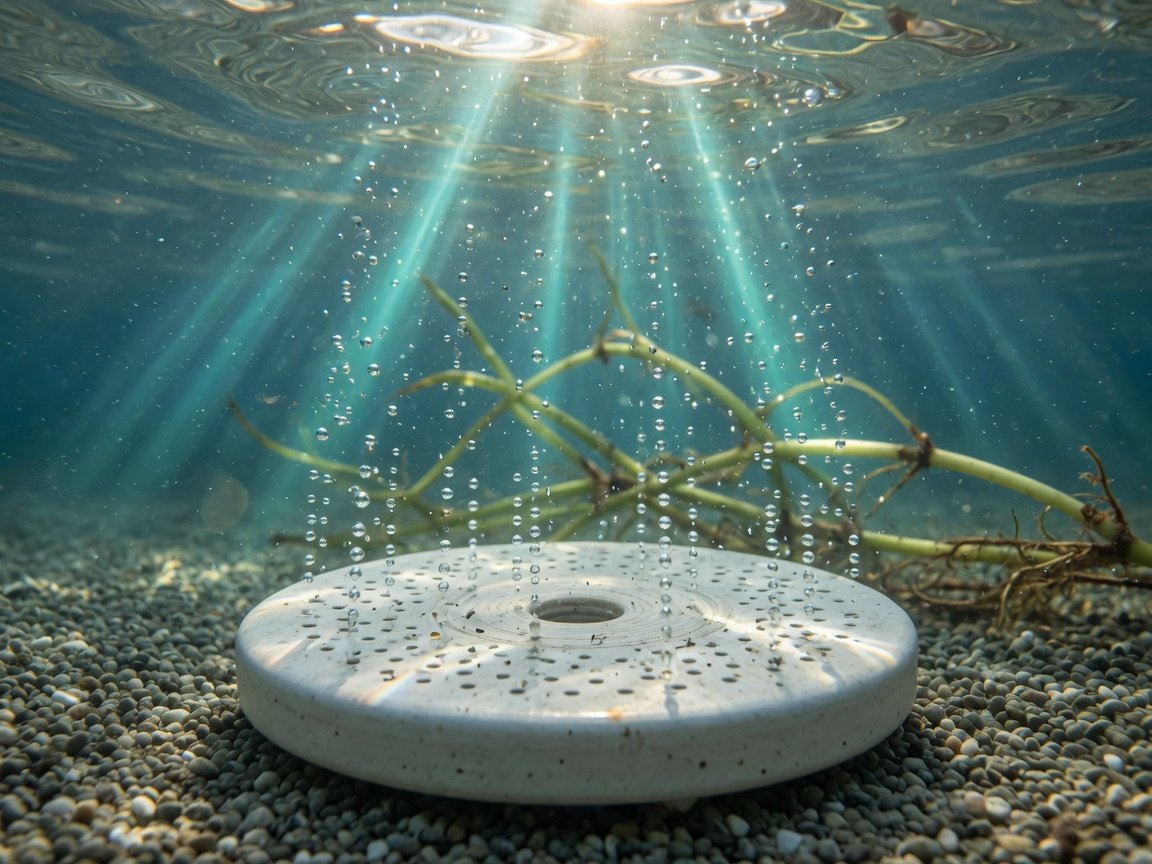
Bottom diffuser systems use an external compressor on the bank to push compressed air through weighted airline tubing to diffuser discs resting on the pond floor. Each disc releases thousands of fine bubbles that rise slowly through the entire water column, transferring oxygen as they travel. By the time those bubbles reach the surface, they’ve oxygenated the water from bottom to top — which is exactly what deeper ponds require.
Because the compressor sits on dry land, maintenance is easy. The pond surface stays relatively calm, which suits koi ponds where a clean, reflective surface is part of the aesthetic. Bottom diffusers are the most effective whole-pond oxygenation solution for ponds deeper than 6 feet. If you’re choosing a compressor to drive your system, our review of the best air pumps for pond aeration compares the leading models across different pond sizes and output requirements.
Surface Aerators (Paddlewheel and Propeller Types)
Surface aerators use a motorised paddle or propeller to agitate the water surface directly, splashing large volumes into the air and creating intense turbulence. They transfer oxygen very efficiently and can handle very large water volumes quickly. The tradeoff is noise, energy consumption, and significant visual disruption — they are not subtle. Surface aerators are common in commercial aquaculture and large ornamental lakes, but for a typical back-garden pond, they’re usually more than the situation calls for.
How Do the Three Aeration System Types Compare?
Use this table as a starting framework. Your pond’s depth and surface area will quickly narrow the right category down.
| System Type | Best Depth Range | Pond Size Fit | Relative Cost | Visual Impact | Maintenance Level |
|---|---|---|---|---|---|
| Fountain Aerator | Up to 6 ft | Small to medium | Low–Medium | High (decorative) | Low |
| Bottom Diffuser | 6 ft+ | Medium to large | Medium–High | Low (subtle) | Low–Medium |
| Surface Aerator | Any | Large to very large | High | Medium | Medium–High |
How Do You Choose the Right Aeration System for Your Pond?
Four variables determine the right match: pond depth, surface area, fish load, and budget. Work through them in order and the decision usually becomes clear.
Start with depth. This is the single most important factor. Ponds 6 feet or shallower are well served by fountain aerators. Ponds deeper than 6 feet need bottom diffuser systems to oxygenate the lower water column. This isn’t a preference — it’s physics. Spray from a fountain aerator simply doesn’t reach deep enough to make a meaningful difference at depth.
Calculate your volume. Work out your pond volume in litres using: length × width × average depth × 1,000. A single bottom diffuser disc typically covers 5,000–8,000 litres effectively, depending on the compressor’s output. Larger ponds need multiple discs distributed evenly across the floor. Under-sizing is one of the most common and costly mistakes pond owners make — an aerator that can’t keep pace with oxygen demand is essentially decorative.
Factor in your fish load. Koi and goldfish produce significant waste and consume more oxygen than most other pond inhabitants. A heavily stocked koi pond needs meaningfully more aeration capacity than a lightly planted wildlife pond of the same volume. If you’re planning your stocking levels and aeration setup together, understanding the factors that shape koi pond capacity helps you size both decisions correctly from the start.
Set a realistic budget — but don’t let it drive the whole decision. Fountain aerators are the most affordable entry point. Bottom diffuser systems cost more upfront but deliver superior whole-pond oxygenation where depth demands it. The cost of replacing stressed or dying fish almost always exceeds the savings from buying a cheaper, underpowered system.
Where Should You Position Your Aerator for Maximum Effect?
Position makes a significant difference — and it’s one of the most frequently overlooked aspects of a new installation. The most common mistake is placing the aerator near the pond edge. Edge placement creates a well-oxygenated zone immediately around the unit and a relative dead zone across the rest of the pond, particularly on the far side.
For fountain aerators, centre placement is the right starting point. It distributes the spray pattern evenly in all directions and drives circulation toward every margin of the pond. For bottom diffuser systems, position the disc or discs in the deepest part of the pond floor. This ensures the rising bubbles travel through the full height of the water column before reaching the surface — maximising oxygen transfer per bubble.
When running multiple diffuser discs in a larger pond, space them in a triangular or grid pattern to avoid overlapping circulation zones and achieve full-footprint coverage. Always anchor everything securely — lightweight fountain floats and airline tubing shift in wind, and a drifted aerator quickly recreates the edge-placement problem you were trying to solve.
How Should You Install a Pond Aeration System Step by Step?
Installation is manageable for most home pond owners and typically takes two to four hours for a standard garden pond. Follow these steps in order for the best result.
- Size and select your system. Confirm your pond depth and volume, then choose the appropriate system type and output rating. When in doubt about sizing, choose the next level up.
- Gather all components before you start. For bottom diffusers: compressor, weighted airline tubing, diffuser discs, and anchoring stakes or weights. For fountain aerators: pump unit, float assembly, nozzle head, and mooring rope or bank anchors.
- Position the compressor on dry land (bottom diffuser systems). Place it on a stable, level surface at least 30 cm from the water’s edge. Most pond compressors are not waterproof — keep them elevated if your area experiences flooding.
- Run the airline tubing to the pond floor. Feed weighted tubing from the compressor across the floor to your chosen diffuser position. Avoid sharp bends or kinks — these restrict airflow and reduce the system’s oxygen output across all discs.
- Secure the diffuser discs or fountain float. Hold diffuser discs flat against the pond floor using stakes or flat weights. For fountain units, position the float centrally and anchor it with a rope fixed to a stake in the bank.
- Connect to a weatherproof outdoor socket and switch on. Check the bubble distribution or spray pattern immediately. Adjust positioning if coverage looks uneven before anchors are fully set.
- Monitor fish behaviour for the first 48 hours. Active swimming at mid-water depth is a good sign. Fish still clustering at the surface indicate the oxygen level hasn’t improved enough — recheck your positioning, output rating, and whether the system is correctly sized for your pond volume.
What Maintenance Does a Pond Aeration System Require?
Aeration systems are low-maintenance by nature — but a small amount of regular attention keeps them running at full efficiency for years. Three things need periodic checking.
Air filter cleaning (monthly). Compressors draw ambient air through an intake filter that accumulates dust, pollen, and debris over time. A clogged filter reduces airflow and strains the motor. Check it monthly and clean or replace it every two to three months depending on how dusty your outdoor environment tends to be. This single maintenance step extends compressor lifespan more than any other.
Diffuser disc inspection (annually). Diffuser membranes gradually become blocked with mineral deposits and biofilm, which reduces bubble output. If you notice declining bubble volume, remove the discs and soak them in a diluted white vinegar solution — approximately 1 part vinegar to 5 parts water — for 24 hours to dissolve mineral scale. Rinse thoroughly with clean water before reinstalling. Replace membranes that remain blocked after soaking.
Airline checks every season. Inspect tubing for cracks, perforations, or persistent kinks. A slow air leak drops pressure across the whole system, reducing oxygenation at every diffuser disc. Damaged sections should be replaced rather than patched — adhesive tape repairs fail quickly in permanently wet environments.
Your maintenance routine also needs to adapt with the seasons. Oxygen demand rises sharply in summer as water temperatures climb and fish metabolism speeds up. Winter brings a different set of adjustments. Our seasonal pond aeration tips walk through the specific changes to make month by month so your system delivers what your pond actually needs at every time of year.
How Does Aeration Protect Your Pond Through Winter?
Winter aeration is widely misunderstood. Many pond owners assume the sensible approach is to switch the aerator off when temperatures drop. For fish ponds, this can be a serious mistake — though the approach does need careful adjustment.
The specific concern with bottom diffusers in cold weather is this: a diffuser running on the floor pulls the warmest water — which settles at the bottom of a cold pond — up to the surface. In near-freezing temperatures, this prevents fish from accessing the thermal refuge they rely on in the coldest spells. The correct winter adjustment is to move the diffuser to shallower water, around 12–18 inches deep, through the coldest months. This keeps a hole open in any ice that forms without disturbing the warmer bottom layer fish need to survive.
Fountain aerators should be switched off when surface temperatures approach freezing. Ice forming around the pump mechanism is a real risk, and spray freezing on surrounding surfaces can cause unexpected damage.
Keeping any opening in ice cover is the critical winter goal. A pond sealed under continuous ice for more than a few days can experience winterkill — a fish die-off from oxygen depletion and toxic gas accumulation that happens faster than most pond owners expect. For a thorough breakdown of the science and the practical seasonal management steps, this guide to winter aeration benefits and ecosystem support covers everything you need to know.
What Role Does Aeration Play in the Nitrogen Cycle?
The nitrogen cycle is the biological process that keeps pond water safe for fish — and dissolved oxygen is what powers it.
Fish excrete ammonia, and decomposing organic matter releases more of it. Two groups of beneficial bacteria — Nitrosomonas and Nitrobacter — convert ammonia first into nitrite and then into relatively harmless nitrate. Both are strictly aerobic organisms: they cannot function without dissolved oxygen. In a low-oxygen pond, this conversion process slows or stalls entirely. Ammonia and nitrite accumulate to toxic concentrations. Fish become stressed, immune systems weaken, and mortalities follow.
Maintaining dissolved oxygen above 6 mg/L gives your nitrifying bacteria the conditions they need to process waste as fast as it’s produced. Consistent aeration means consistent biological filtration — which means stable water chemistry even as fish feeding rates and organic load fluctuate across the seasons. The Pondineer’s guide to the nitrogen cycle and algae control explains the full biological process and its direct connection to water clarity and fish health.
When Should You Run Your Pond Aerator?
For any pond stocked with fish, the answer is continuously — 24 hours a day, seven days a week. Oxygen demand doesn’t pause at night. In fact, dissolved oxygen levels are typically lowest between midnight and dawn. During daylight hours, aquatic plants and algae produce oxygen through photosynthesis. After dark, they reverse that process and consume oxygen instead. Running your aerator only during the day means your fish face their most depleted conditions with no support at the most vulnerable time.
If electricity costs are a genuine concern, the most impactful windows to run an aerator are overnight and during the warmest part of the afternoon — when warm water holds less dissolved oxygen and fish metabolism is highest. A timer set to cover those windows delivers the most protection for the least energy expenditure.
Wildlife ponds without fish are more forgiving. Amphibians and aquatic invertebrates benefit from aeration but tolerate more oxygen fluctuation than koi or goldfish. A system running six to eight hours during the warmest part of the day typically keeps a wildlife pond in healthy condition through the growing season.
How Does Aeration Improve the Beauty of Your Pond?
The health benefits make a compelling practical case for aeration. But the visual transformation is usually what surprises pond owners most — and what makes the investment feel immediately worthwhile.
Clear water is the most immediate change. When aerobic bacteria are working at full capacity, they consume the suspended organic particles that cloud water and give it a flat green or brown tint. A correctly sized aeration system typically clears a pond noticeably within two to four weeks of installation. With consistent aeration, that clarity becomes the new baseline — not something dependent on repeated chemical treatments to maintain.
Fewer algae blooms mean less time scrubbing walls and dosing treatments, and more time actually enjoying the pond. Clear water showcases your fish at their best — koi colours look richer, fish are more visible and active at mid-water depth, and the whole pond becomes a genuine garden feature rather than a maintenance problem you try to avoid looking at.
The movement itself adds something hard to quantify. The gentle visual rhythm of a fountain, or the subtle surface ripple from a bottom diffuser, catches and scatters light differently at every hour of the day. Early morning, midday, and dusk each look different. That quiet, constant animation is often what makes visitors stop and look at the pond properly for the first time — and what makes you glad you built it.
Frequently Asked Questions About Pond Aeration Systems
Can I install a fountain aerator in a deep pond?
Yes, but with an important limitation. Fountain aerators oxygenate primarily the top layer of the water column. In a pond deeper than 6 feet, the bottom water will remain poorly oxygenated even with a fountain running continuously at the surface. For deep ponds, a bottom diffuser system is the correct primary solution. You can run a fountain alongside a bottom diffuser for the visual benefit — just don’t rely on it alone to oxygenate a deep pond.
How do I know if my pond has enough dissolved oxygen?
The clearest behavioural sign of low oxygen is fish surfacing to gulp air — particularly in early morning, when overnight depletion peaks. Lethargic fish, increased susceptibility to disease, and a sulphur or rotten-egg smell from the water are other strong indicators. A dissolved oxygen test kit or digital DO meter gives you a reliable reading. Levels below 5 mg/L indicate a problem for stocked fish ponds. Aim to maintain above 6 mg/L consistently.
Should I run my aerator in winter?
For fish ponds, yes — but the approach needs adjusting by system type. Switch off fountain aerators when surface temperatures near freezing to protect the pump mechanism. For bottom diffuser systems, move the diffuser disc to 12–18 inches depth through the coldest months. This keeps a hole open in any ice cover without pulling the warmer bottom water your fish depend on to the surface. Never leave a fish pond sealed under unbroken ice for more than a day or two without maintaining some form of gas exchange.
How long before I see results after installing a pond aeration system?
Fish behaviour often improves within 48 hours as oxygen levels rise. Water clarity typically becomes noticeably better within two to four weeks as aerobic bacteria become more active and your biological filter gains efficiency. Algae reduction takes longer — particularly where there’s a large existing nutrient load in the sediment — but consistent aeration delivers a meaningful reduction in algae frequency and severity across a full season compared to unaerated conditions.
Can pond aeration replace my pond filter?
No. Aeration and filtration serve different functions. Aeration raises dissolved oxygen and promotes water circulation. Filtration removes suspended particles mechanically and converts ammonia and nitrite through biological media. A well-aerated but unfiltered pond will still accumulate suspended waste and run into water quality problems. The two systems work best together: aeration improves the efficiency of your biological filter and makes your mechanical filter more effective, but it does not replace either function.
What size aerator do I need for my pond?
Start with your pond volume in litres: length × width × average depth × 1,000. A single bottom diffuser disc typically covers 5,000–8,000 litres effectively. For heavily stocked koi ponds or ponds carrying a significant organic load, size up by at least one category. For fountain aerators, match the pump’s output to your pond surface area and check the manufacturer’s recommended maximum pond volume on the product specification.
Does pond aeration use a lot of electricity?
Not typically. Most domestic pond compressors for bottom diffuser systems run at between 20 and 80 watts — comparable to a light bulb or LED floodlight. Fountain pump units vary by size but small garden pond models generally run in a similar range. Running costs are modest and consistently small compared to the alternative: treating persistent algae, medicating sick fish, or replacing casualties from oxygen depletion.
What Are Your Next Steps for Setting Up Your Pond Aeration System?
Getting aeration right is one of the highest-return decisions you can make for your pond. Better water quality, healthier fish, fewer algae problems, and a clearer, more beautiful pond all follow from consistent, correctly sized oxygenation. Here is a simple action plan to get started.
- This week: Measure your pond’s depth, surface area, and estimate volume. Determine whether you need a fountain aerator (under 6 ft) or a bottom diffuser system (6 ft or deeper).
- Before purchasing: Calculate the output you need based on your pond volume and fish load. Size up if your stocking density is high or your organic matter load is significant.
- At installation: Position centrally, anchor securely, and monitor fish behaviour for 48 hours before making any adjustments to placement or output.
- Seasonally: Check air filters monthly, inspect diffuser discs annually, and adapt your setup for cold weather — particularly as surface temperatures approach freezing.
A correctly sized, well-positioned aeration system should run reliably for years with minimal intervention. Get the fundamentals right from the start — depth, sizing, and placement — and your pond will reward you with clear water, active fish, and a garden feature you’re genuinely glad you built.