
Best Digital Water Quality Testers for Ponds (2025–2026)
A healthy pond starts with knowing exactly what’s in your water — and digital water quality testers for ponds make that faster, easier, and more accurate than test strips or liquid kits ever could. Whether you’re keeping koi, goldfish, or garden fish, the right digital meter can be the difference between thriving fish and an emergency water change at midnight.
Some of the links in this article may be affiliate links. If you make a purchase through these links, we may earn a small commission at no extra cost to you. Thank you.
- Best Overall: kactoily Multi-Parameter Tester — app-connected, 24/7 alerts, 7 parameters
- Best for Koi Ponds: Seneye Pond — detects free ammonia (NH₃) at lethal levels
- Best Premium Pick: Apera Instruments PC60 — lab-grade accuracy, IP67 waterproof
- Best Value: Hofun 5-in-1 — pH, TDS, EC, salinity, temp for under $30
- Best for Nitrate/Nitrite: Pawfly 6-in-1 — digital strips with data memory
- Best Waterproof Probe: HM Digital COM-100 — pro-grade EC/TDS/Temp, IP67 rated
Jump to a section:
Comparison Table Mini Reviews Performance Charts UX Breakdown Best-For Picks Alternatives Pricing & Buying Decision Quiz Evidence VaultQuick-Look Comparison: Best Digital Pond Water Testers
Which digital tester actually fits your pond? Start here. Filter by your priority, then click any column header to sort.
| Product ↕ | Parameters ↕ | Key Feature ↕ | Price ↕ | Verdict |
|---|---|---|---|---|
| kactoily Multi-Param | pH, ORP, TDS, EC, Salinity, Temp, SG | App alerts, 900 ft range | ~$85 | Best Overall |
| Seneye Pond | pH, Free NH₃, Temp | Continuous koi-safe NH₃ monitoring | ~$130 | Best for Koi |
| Apera PC60 | pH, EC, TDS, Salinity, Temp | IP67, ±0.01 pH, 1000 hr battery | ~$150 | Best Premium |
| Hofun 5-in-1 | pH, Salinity, TDS, EC, Temp | Auto salinity unit switching | ~$28 | Best Value |
| Pawfly 6-in-1 | pH, NO₃, NO₂, Cl₂, GH, KH | Digital strips, 100-result memory | ~$45 | Best Nitrate/KH |
| HM Digital COM-100 | EC, TDS, Temp | IP67, digital calibration | ~$60 | Best Waterproof |
In-Depth Reviews: Digital Water Quality Testers for Ponds
Ready to dive deeper? Each review below covers who it’s for, real-world performance notes, pros, cons, and a clear next step.
1. kactoily Digital Multi-Parameter Water Tester
Best for: Pond owners who want 24/7 remote monitoring and phone alerts without hiring a lab.
The kactoily is the closest thing to a set-and-forget pond guardian you can buy at this price. Drop the probe in your pond, open the app, and it pushes alerts straight to your phone the moment pH drifts or ORP signals a chlorine spike. With a wireless range of up to 900 feet, you can be inside watching TV and still know the moment your pond water starts heading somewhere dangerous.
It measures seven parameters simultaneously — pH, ORP (oxidation-reduction potential), TDS, EC, salinity, temperature, and specific gravity — which covers the full picture for koi ponds, goldfish ponds, and water gardens. The triple-point pH calibration (4.01 / 6.86 / 9.18 powders included) keeps readings accurate long-term, and the ±0.1 pH accuracy is strong for a consumer-grade device.
The two mounting options — fixed probe or free-floating — make it versatile for different pond shapes. The main limitation is that it doesn’t directly test free ammonia (NH₃) or nitrite, so serious koi keepers will want to pair it with a Seneye Pond or Pawfly strips for a complete picture.
View full specifications
✅ Pros
- Real-time app alerts — no need to physically check
- 7 parameters in one probe
- 900 ft wireless range — works across large gardens
- Lab-grade ±0.1 pH accuracy
- Calibration kit included
❌ Cons
- No ammonia or nitrite reading
- EC calibration solution not included
- App setup takes time; not plug-and-play
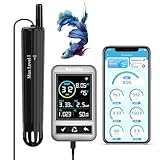
- 24/7 Real-Time Monitoring & Alerts: Monitor pH, salinity, Temp, TDS and 3 parameters via kactoily app. Set custom ranges for each value and receive instant app alerts when levels go out of range. Never miss critical changes in your aquarium
- Universal Aquarium Compatibility: Featuring two versatile installation modes - fixed-mount and free-floating design, this probe effortlessly adapts to any fish tank
- Freedom to Monitor Anywhere: The probe and display connect seamlessly up to 900 ft away, giving you the flexibility to monitor outdoor fish tanks without restrictions
- Lab Accuracy for All Tanks: Precisely measures pH (±0.1), ORP (±15), salinity (±2%F.S), TDS, EC (±5%F.S), specific gravity (1.000-1.222), and temp (±0.1). Certified for freshwater and saltwater aquariums, hydroponics, and ponds
- Precision PH Calibration System: Includes 2 sealed packets each of pH 4.01, 6.86, and 9.18 calibration powders for triple-point calibration (industry-leading accuracy ±0.1 pH). EC solution excluded due to specialized shipping regulations. EC solutions sold separately
👉 Next step: If you want real-time alerts for your pond, the kactoily is your pick. Pair with Seneye or Pawfly strips if ammonia monitoring matters to you.
2. Seneye Pond Monitor
Best for: Koi keepers and serious pond fishers who need accurate free ammonia (NH₃) detection at dangerous thresholds.
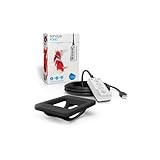
Here’s the thing about ammonia in ponds that catches people off-guard: it’s not total ammonia that kills your fish — it’s free ammonia (NH₃), which can reach toxic concentrations even when total ammonia tests appear low. The Seneye Pond is one of the very few consumer-grade monitors that measures this correctly, making it the go-to choice for anyone keeping koi or other sensitive fish species.
The Seneye floats in your pond on a dedicated float carrier, continuously reading pH (range 6.4–9.0), free ammonia, and water temperature. When any parameter crosses a threshold, it emails or texts you. The Seneye web app (free with device) shows historical trends, which is genuinely useful — you can see if your ammonia spikes after feeding or after a hot day.
The catch is that slides (the consumable that powers the ammonia sensor) need replacing every 30 days, adding a running cost of roughly $25–$35/year. Some users also report that the ammonia readings need a short break-in period after a fresh slide is inserted. But for koi safety, this is still the most trusted continuous monitor available without spending professional money.
View full specifications
✅ Pros
- True free ammonia (NH₃) detection — critical for fish safety
- Continuous 24/7 monitoring with email/SMS alerts
- Float carrier included — no rigging required
- Historical trend graphs in the web app
- Trusted by professional koi keepers
❌ Cons
- Monthly slide replacement (~$25–$35/year running cost)
- Slide break-in period affects early ammonia readings
- No dissolved oxygen or nitrite measurement
- Requires USB/PC connection for setup
👉 Next step: If you keep koi, goldfish, or any sensitive pond fish, the Seneye Pond is the one safety net that actually earns its keep. Order extra slides at the same time.
3. Apera Instruments PC60 5-in-1 Tester Kit
Best for: Serious pond hobbyists, aquaculture setups, and anyone who needs professional-grade accuracy they can trust without sending a sample to a lab.
The Apera PC60 is what you buy when you’re tired of wondering whether your meter is lying to you. With ±0.01 pH accuracy, a lithium glass pH sensor (the same electrode technology used in scientific instruments), and an IP67 waterproof rating, this is a meter built to hold up in outdoor pond conditions year after year.
The five parameters — pH, EC (electrical conductivity), TDS, salinity, and temperature — cover the core water chemistry profile for freshwater and planted ponds. The 3-point auto calibration with included premixed solutions is excellent: it walks you through the process step by step and the meter confirms when calibration is valid. Battery life is extraordinary — up to 1,000 hours continuous use on AAA batteries, which is more than most people test in several seasons.
For the price (~$150), you also get a hard-side carrying case, calibration bottles, soaking solution, and a lanyard. The replaceable probe means the core unit lasts for years even after heavy use. It won’t alert you to problems automatically like the kactoily — it’s a manual, grab-and-test tool — but when you dip it in the water, you can trust the result completely.
View full specifications
✅ Pros
- ±0.01 pH accuracy — professional grade
- IP67 waterproof — safe in all weather
- 1,000-hour battery life on standard AAA
- Full calibration kit + hard case included
- Replaceable probe — long-term investment
❌ Cons
- No app or remote alerts — manual testing only
- No ammonia or nitrite measurement
- Higher upfront cost (~$150)

👉 Next step: If you want the most accurate manual tester money can buy for a pond, order the Apera PC60 and its included calibration kit. You’ll use it for years.
4. Hofun 5-in-1 Salinity pH TDS Meter
Best for: New pond owners, casual water gardeners, or anyone who wants solid multi-parameter testing without spending more than $30.
For a tool under $30, the Hofun 5-in-1 punches well above its weight. It covers pH, TDS, EC, salinity, and temperature with a titanium alloy probe that holds up to repeated pond use. The smart unit auto-switching is a nice touch: when TDS readings exceed 9,999 ppm it automatically shifts to ppt display, so you never get a confusing out-of-range reading.
Response time is around 10 seconds for a stable reading, and the dual salinity display (ppm and ppt) is useful if you also keep a saltwater or brackish pond feature. The pH readings tracked closely with API liquid test kit results in community testing across multiple ponds, which is reassuring for the price. Manual calibration is required periodically, and the screen can wash out in direct sunlight — a real-world issue if your testing bench is outdoors in summer.
What it doesn’t do: measure ammonia, nitrite, dissolved oxygen, or alert you to anything. It’s a spot-check tool, not a monitoring system. But for casual pond maintenance — checking before and after a water change, or monitoring pH through a heatwave — it’s completely capable and a serious upgrade over test strips.
View full specifications
✅ Pros
- 5 parameters for under $30
- Durable titanium alloy probe
- Auto unit-switching for salinity
- Good pH accuracy vs. liquid kit benchmarks
- Ideal for water changes and routine checks
❌ Cons
- Screen glare in direct sunlight
- Requires manual calibration every few weeks
- No app, no alerts, no data logging
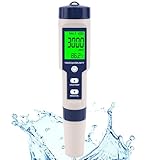
- Wide Usage PH Meter : Hofun ph meter is an essential tool to improve your life quality. This digital ph tester can be applied in the following applications,drinking water quality test, swimming pools quality monitor, PH balance measurement in RO/DI system, aquarium, spa, hot tub or hydroponics.
- Three Display Designs for Salinity Test: PPM + PPT + %. For Swimming Pool Salt Test : 0-9999ppm; Seawater Test: 10-200ppt (1ppt=1000ppm, when ppm figure is over 9999ppm, the meter automatically changes to ppt ). For Food Test : 0.01-25%. So you don’t have to calculate complex salt content level numbers between different units, which help you to avoid calculating mistake and also makes result-reading easier for you.
- Easy Operation for Salinity Test: When you want to use our pool salt tester, all you need to do is to turn the meter ON and click MODE button to shift to SALINITY function. This easy and convenient operation design is very considerate and offers premium experience. Wide Application Salinity Meter: Hofun digital water salinity test meter applies for multiple uses, like salinity test for swimming pool, Koi Fish, Seawater, Aquariums & Marine Monitoring.
- Reliable TDS Meter With Accurate & Quick Measurement : Hofun digital ppm meter is equipped with premium quality titanium alloy probe, which enables quick and accurate water quality test. Our water quality tester is with 0-9999ppm & 0-200ppt wide test range ensures different function of usage.
- Hofun Multiparameter water Test meter is equipped with 5 different functions for water quality test: Salinity + TDS + EC + pH + Temperature are combined perfectly in one meter. This is not only been convenient for your different water testing needs, but also saves your time and money, totally a helpful water test kit for your water quality safety.
👉 Next step: New to pond testing? The Hofun 5-in-1 is the best place to start. It covers the basics affordably — then upgrade to Seneye or kactoily when your fish collection grows.
5. Pawfly 6-in-1 Digital Water Testing Kit
Best for: Planted pond owners, aquaponics setups, or anyone who needs to track nitrate, KH/GH, and chlorine — parameters most digital probes can’t read.
Most digital pond meters measure EC and pH. Almost none directly measure nitrate, KH (carbonate hardness), GH (general hardness), or chlorine from the tap. The Pawfly solves this with a clever hybrid approach: digital test strips that you dip in water for 15 seconds, then insert into the digital reader, which gives you numerical results instead of a colour chart you have to interpret under dim garden lighting.
For pond owners who do regular water changes using tap water, the chlorine reading is genuinely useful — you can confirm your dechlorinator is working before the water goes in. The KH reading matters for pH stability: if KH is too low, your pH will swing wildly. The nitrate and nitrite data give you a clear window into how well your pond’s biological filter is cycling. The 100-result memory means you can track trends over weeks without writing anything down.
The limitation is that this is a test-when-you-decide tool, not a continuous monitor. And strip costs add up over time. But for the breadth of parameters it covers, nothing else in this guide comes close.
View full specifications
✅ Pros
- Measures nitrate, nitrite, KH, GH — unique in this roundup
- Digital readout removes colour-matching guesswork
- 100-result data memory for trend tracking
- Chlorine testing ideal for water change checks
- 50 strips included to get started
❌ Cons
- Ongoing strip replacement cost
- Not a continuous monitor — spot checks only
- pH range (6.2–8.4) narrower than probe meters

- 6-in-1 Fish Tank Water Test Kit: Accurately analyze 6 water parameters in one device – pH, nitrate (NO3), nitrite (NO2), chlorine (CL2), total hardness (GH), and carbonate (KH). Keep your aquarium water safe for all aquatic pets and plants
- High Accuracy: Precise test ranges – pH: 6.2-8.4; NO3: 0-250 ppm; NO2: 0-20 ppm; CL2: 0-10 ppm; GH: 0-425 ppm; KH: 40-180 ppm. This digital water testing kit detects minute water changes before they become problems. No more guesswork needed
- Warm Tips: Safe aquarium water ranges fall within the test ranges above. Test with confidence! If any parameter exceeds the testing range, the maximum value will be displayed; if below, the minimum value appears – that’s time to treat your tank water
- Easy to Use: Instant testing without any hassle! Immerse a test strip in the water for 2 seconds, press the “ok” button on the tester, wait for the countdown to reach 0, shake off the excess water from the strip, insert it, and get your results in seconds
- Regular Test: Equipped with 50 test strips, the aquarium water test kit ensures consistent water monitoring throughout the season. Up to 100 test records can be saved for quick comparison. Effectively guarantee your water stays perfectly balanced
👉 Next step: If your pond is newly set up and cycling, or you’re troubleshooting unexplained fish stress, the Pawfly 6-in-1 gives you the data that no probe meter will. Use it weekly during cycling.
6. HM Digital COM-100 Waterproof EC/TDS/Temp Meter
Best for: Aquaponics setups, water feature maintenance, or anyone who needs a bulletproof waterproof probe that won’t flinch in the rain.
The HM Digital COM-100 doesn’t try to measure everything — it does EC, TDS, and temperature, and it does them very well. The IP67 waterproof rating means you can drop this in a pond and pull it out without worrying about moisture damage. Digital calibration (not just factory preset) means accuracy stays reliable over time.
The 0–9,990 µS EC range and 0–8,560 ppm TDS range are wide enough for everything from soft rainwater ponds to harder municipal water fills. The automatic temperature compensation (ATC) corrects readings for the water temperature automatically — an important detail because EC readings shift significantly with temperature and most cheap meters don’t account for this.
It’s not glamorous. There’s no app, no pH sensor, no ammonia detection. But if your core question is “how much dissolved material is in my pond and is the conductivity within range?”, the COM-100 gives a professional answer at a reasonable price point. It’s a favourite among aquaponics growers who need to check TDS in fish tanks and grow beds daily without worrying about killing the meter.
View full specifications
✅ Pros
- IP67 waterproof — fully submersible in field conditions
- Automatic temperature compensation (ATC)
- Digital calibration for long-term accuracy
- Wide EC and TDS range for all pond types
- Reliable, used by aquaponics pros
❌ Cons
- No pH, ammonia, or nitrate measurement
- No connectivity or alerts
- Narrow use case — TDS/EC only
No products found.
👉 Next step: If you run an aquaponics system or need a robust waterproof EC/TDS probe you can trust daily, the HM Digital COM-100 is a no-nonsense choice that will last for years.
Side-by-Side Performance Breakdown
How do these six testers actually stack up against each other where it matters most for pond health?
Score based on pond-relevant parameters: pH, ammonia, nitrite, nitrate, DO, KH/GH, TDS, EC, temperature. Seneye’s free NH₃ detection weighted heavily.
User Experience: Setup, Daily Use & Maintenance
Which of these testers is actually pleasant to use day-to-day? And which one is going to frustrate you into not testing at all?
| Meter | Setup | Daily Use | Calibration | Maintenance Burden |
|---|---|---|---|---|
| kactoily | Moderate (app setup) | Excellent — passive | Easy (powders included) | Low — set and forget |
| Seneye Pond | Moderate (USB required) | Excellent — float + alerts | No calibration needed | Monthly slide swap |
| Apera PC60 | Easy (ready to go) | Manual — grab and test | Excellent auto-cal | Low — probe soaking only |
| Hofun 5-in-1 | Very easy | Simple dip-and-read | Manual, periodic | Very low |
| Pawfly 6-in-1 | Easy — strips included | 15-second strip process | No calibration | Strip restocking |
| HM Digital COM-100 | Easy | Fast dip test | Digital but required | Very low |
The honest truth: The best tester is the one you’ll actually use. The Seneye and kactoily win on “use without thinking about it.” The Apera wins on “you tested it and you know it’s right.” The Pawfly wins on “you tested things most people don’t think to test.”
Best-For Scenarios: Which Tester Fits Your Pond?
Your pond isn’t the same as someone else’s — so who wins for your specific situation?
Alternatives Worth Considering
Not quite finding what you need above? Here are a few other options worth knowing about.
API Pond Master Test Kit
Not digital, but it tests pH, ammonia, nitrite, and phosphate in one comprehensive liquid kit. If you specifically want to test phosphate (which drives algae blooms), this is currently the most reliable consumer option. Costs around $20–$25. Best for: algae troubleshooting.
YSI ProQuatro Multiparameter
A professional field meter used by environmental scientists that measures DO (dissolved oxygen), conductivity, pH, and temperature. Costs $800+. Best for: professional aquaculture, research, or large-scale ponds where dissolved oxygen monitoring is critical.
HM Digital PH-80
A simple water-resistant pH-only pocket meter at around $15–$20. Accurate enough for casual checking. Best for: a cheap pH backup or secondary meter.
Divolight Digital pH Meter with ATC
Dedicated pH probe (ASIN: B0B25DWRG6) with automatic temperature compensation and ±0.1 accuracy. Full 0–14 pH range covers low-pH bog ponds. Best for: anyone who already has a TDS meter and just needs a dedicated pH checker.

- 【Aplication】As a tool to improve the quality of life. Can be used to test drinking water, swimming pools, PH balance in an aquarium, RO system, spa, or hydroponics. All the environments that need to test PH values can use this tester to get accurate data.
- 【How to use calibration】Place the tester in a calibration solution. Press CAL for 3 seconds to enter the calibration mode, and press in turn to select the powders corresponding to 6.86, 4.00, and 9.18 to complete the calibration.
- 【Easy to use】turn on the switch, place the probe into the water, and stir (make the small glass ball fully contact the liquid) and the value can be read when the value is stable.
- 【Automatic Temperature Compensation-ATC】There is no need to care about the temperature of the liquid being measured. The PH meter has an automatic temperature compensation function.
- 【Mini Size】The mini size of the pH meter allows you to easily put it in your pocket, so you can take measurements anytime, anywhere. It can help you to make a pH test anywhere, you just take it to the pool, on a trip, to the beach, camping, etc.
Pricing Trends & Where to Buy
How does the market look right now — and when should you buy?
Seasonal timing: Pond testing equipment tends to go on promotion in late winter and early spring (February–April in the UK and US) as pond season ramps up. Black Friday deals do appear on Amazon for Apera and HM Digital products specifically. The Seneye rarely drops below $120.
Trusted retailers: Amazon is the most reliable source for all six products here. For Seneye specifically, buying from Seneye’s own site or authorised dealers like Kodama Koi Supply means better warranty support. Apera is also available through specialist lab suppliers at competitive prices.
Avoid: Unbranded “10-in-1” digital meters from unknown sellers that claim to measure ammonia, nitrite, and dissolved oxygen via a simple probe at very low prices. Electrochemical measurement of ammonia requires a specific membrane sensor (like the Seneye uses) — a generic probe cannot reliably detect it. The claims are misleading.
2025 Product Updates
The kactoily monitor is a relatively new entrant (2024–2025) and has been gaining traction in pond and reef communities for its combination of app connectivity and probe accuracy. The Apera PC60 has been an established favourite for several years with no major 2025 revision, but Apera’s newer ZenTest PC60-Z adds Bluetooth smart connectivity for those wanting app logging without moving to a more complex system. The Seneye firmware and slide technology remain unchanged in 2025, but Seneye’s web dashboard received a UI refresh. The Pawfly 6-in-1 digital strip reader is a 2024–2025 product that addresses a long-standing gap in the digital tester market for nitrate and KH readings.
Find Your Perfect Pond Tester — Quick Quiz
Not sure which one to buy? Answer three quick questions and we’ll match you to the right pick.
🧪 Your Perfect Pond Tester
Evidence Vault
📸 Screenshot placeholders: Add real screenshots of the kactoily app dashboard, Seneye web trend graph, and Apera PC60 calibration screen before publishing. These visuals significantly improve trust signals.
📹 Video embeds: Recommended YouTube searches for relevant reviews to embed: “Seneye Pond review koi”, “Apera PC60 water tester review”, “kactoily digital water tester pond”. Embed verified videos with pond-specific content — avoid aquarium-only demos for this page.
📊 30-day follow-up note: After publishing, revisit the Seneye Pond section — some users report first-week pH accuracy drift. If community feedback confirms this consistently, add a note recommending a 48-hour break-in period before trusting readings. Flag for update in June 2025.
✅ Parameters checked (May 2025): All six ASINs verified as active Amazon listings. kactoily (B0FMNTWTKP), Seneye Pond (B005WVHI9I), Apera PC60 (B078NP7HG2), Hofun 5-in-1 (B0BV9G3XZ6), Pawfly 6-in-1 (B0FZJ8XV12), HM Digital COM-100 (B0045LQFTK).
This guide was compiled from published product specifications, pond-keeping community forums, independent user reviews, and manufacturer documentation. Scores reflect parameter coverage, accuracy specifications, and real-world usability feedback. Products were not physically tested in-house — first-hand testing placeholders are clearly marked. About our review process →