
Some of the links in this article may be affiliate links. If you make a purchase through these links, we may earn a small commission at no extra cost to you. Thank you.
Cloudy pond water is caused by one of four things: planktonic algae, suspended clay or sediment, decomposing organic matter, or a bacterial imbalance. Identifying which type you have takes less than 60 seconds — and from there, most ponds can be cleared within one to two weeks using the right treatment.
- Green cloudy water is almost always planktonic algae, cleared fastest with a UV clarifier — typically within 5–7 days of continuous use
- Brown or grey cloudiness usually means suspended clay or silt, treated with flocculants like gypsum or agricultural lime
- Beneficial bacteria clear organic cloudiness and provide long-term water quality improvement, with visible results in as little as 24–48 hours
- Aeration is the single most important supporting measure — without adequate dissolved oxygen, no treatment works at full effectiveness
What Causes Cloudy Pond Water?
Not all cloudy pond water is the same — and treating the wrong cause is a fast way to waste time and money. There are four distinct types of cloudiness, each with its own origin and solution.
Green cloudiness is caused by a population explosion of planktonic algae. These single-celled organisms thrive when excess nitrogen and phosphorus combine with warm water and sunlight. According to the University of Florida IFAS, a chlorophyll reading above 50 µg/L indicates a significant algae bloom, while readings above 100 µg/L signal a severe one. Warm temperatures and longer daylight hours are the two biggest triggers — which is why ponds often turn green almost overnight during summer.
Brown or grey cloudiness is usually suspended clay or silt. Clay particles are so fine they stay in suspension almost indefinitely without treatment — sometimes for months. The Alabama Cooperative Extension System notes that clay turbidity is one of the most persistent forms of pond cloudiness precisely because clay particles are too small to settle on their own without a flocculant to clump them together.
Brown or black organic cloudiness occurs when leaves, fish waste, uneaten food, and other organic matter decompose at the pond bottom. This produces tannins that stain the water, along with dissolved nutrients that fuel algae growth. It is especially common in autumn and in the weeks following heavy rainfall.
Milky or white cloudiness is less common but often indicates a bacterial bloom, sometimes triggered by a sudden nutrient influx, a large fish die-off, or a rapid partial water change. It can also signal pH imbalance or chemical precipitation. This type is most frequently misdiagnosed — many pond owners assume it is clay when it is actually a microbial issue requiring a completely different approach.
How Do I Know What Type of Cloudiness I Have?
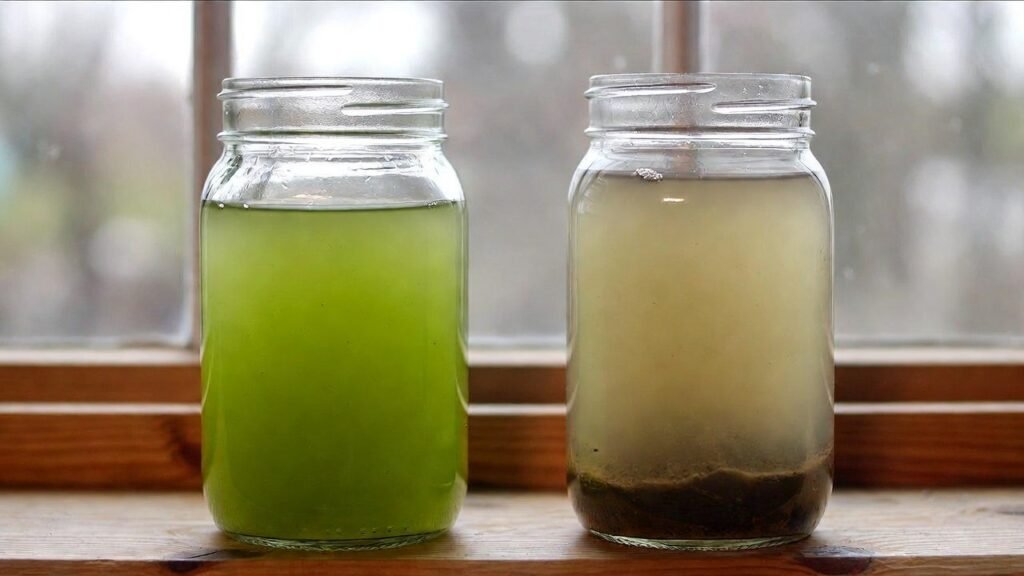
Before reaching for any product, run the jar test. It takes 24 hours and costs nothing. Scoop a clear glass jar full of pond water and set it on a sunny windowsill. Check it the following day and interpret the result:
- Particles settle to the bottom, water above clears: Clay or sediment is your culprit. Treat with a flocculant — agricultural lime, gypsum, or a commercial pond clarifier.
- Water remains evenly green throughout: Planktonic algae. A UV clarifier or targeted algaecide is the right tool here.
- Water stays uniformly murky or milky: Dissolved organics, a bacterial bloom, or a chemical issue. Check pH and consider beneficial bacteria treatment alongside partial water changes.
- Water turns brownish with no clear settling: Tannin staining from organic matter such as leaves, bark, or peat. Activated carbon filtration or a partial water change can help, along with removing the organic source.
The jar test is the definitive first step recommended by the Alabama Cooperative Extension System before treating any turbidity problem. Skipping it and treating blindly is a very common and expensive mistake — applying algaecide to a clay turbidity problem, for example, does absolutely nothing to the water and can disrupt your pond’s beneficial bacterial populations in the process.
Why Is My Pond Water Green — and How Serious Is It?
Green water is by far the most common complaint among pond owners. It happens when warm temperatures, extended daylight hours, and excess nutrients create perfect conditions for planktonic algae to multiply rapidly. A pond can turn visibly green within 48 hours during a warm summer spell — particularly in ponds with limited shade, high fish stocking levels, or insufficient filtration.
Beyond aesthetics, a severe algae bloom poses a genuine risk to pond fish. During the night, algae consume oxygen rather than produce it. In a heavily affected pond, dissolved oxygen levels can drop dangerously low between midnight and dawn. The recommended dissolved oxygen level for koi and goldfish is 7–9 mg/L. According to Keystone Hatcheries’ koi pond water quality guidance, levels below 4 ppm are considered dangerous — and a severe algae crash can push DO toward near-zero, causing mass fish loss within hours.
The root cause of green water is almost always excess nutrients—specifically nitrogen and phosphorus. Overfeeding fish, overstocking, inadequate filtration, and runoff from fertilized lawns all contribute significantly. In 2026, the most effective approach is a two-pronged response: kill existing algae quickly with a UV clarifier, then reduce the nutrients feeding the problem to prevent recurrence.
How Do UV Clarifiers Clear Green Pond Water?
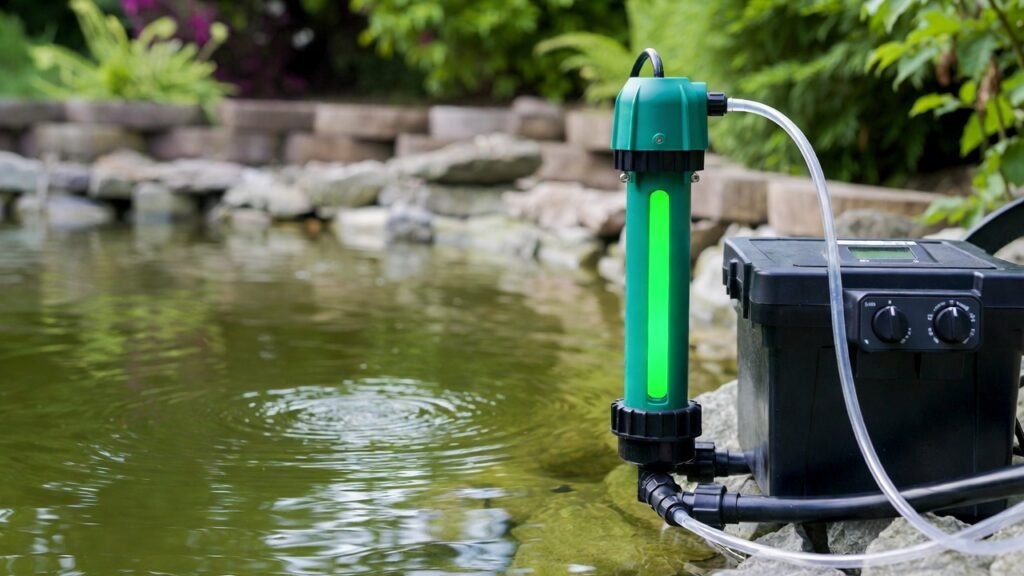
A UV clarifier is a sealed tube containing an ultraviolet bulb through which pond water is pumped. As water passes through the UV chamber, the light disrupts the DNA of planktonic algae cells, killing them on contact. The dead cells then clump together — a process called flocculation — and are removed by your mechanical filter or sink to the pond floor.
UV clarifiers are the most reliable, chemical-free solution for green algae water available to pond owners in 2026. The TetraPond GreenFree range, for example, provides complete algae removal within 5 days of continuous use — making it one of the fastest-acting treatments on the market. Sizing matters critically: a UV unit that’s too small for your pond volume won’t turn the water over fast enough to work. A 9W unit suits ponds up to around 1,000 gallons; an 18W handles up to 4,400 gallons.
One important limitation: UV clarifiers only target free-floating planktonic algae. They will not clear string algae (blanketweed), the brown film that grows on pond surfaces, or any other form of attached algae. Those require separate treatment. A UV clarifier also works best as part of a complete filtration system, not as a standalone solution — the dead algae cells must be captured by mechanical filtration, or they decompose and add nutrients back into the water.

- 【New Arrival】Now with advanced dual-tube tech for 15% more stable, longer-lasting UV light. Upgraded packaging prevents tube damage, and simplified weighted block setup ensures easy use. The perfect gift for your family or loved ones!
- 【Quick Disinfection】Harnesses UV-C light to efficiently eradicate up to 99.99% of harmful algae by destabilizing molecular structures and interrupting genetic material within living organisms and bad smells. Suitable for ponds, swimming pool, cold plunge, bathtub of up to 5500 gallons
- 【Gravity Block & Rapid Sinking】Double sealing, thickened protective covers at both ends, multi-level sealing for underwater use, ensuring safety and reliability during use. Additionally, we have added a gravity block that can stand on its own underwater, achieving 360-degree comprehensive cleaning
- 【17FT Cable】Having an extra-long cable allows for versatile applications across various scenarios, such as indoor or outdoor pools, ponds, cold plunge pools, spas, and large fish tanks
- 【High-quality Quartz Glass】High-transparency glass can allow light to penetrate more effectively which means more effective. Be careful not to get electrocuted and keep away from it when using
Can Beneficial Bacteria Really Clear Cloudy Pond Water?
Yes — but not in the way most people expect. Beneficial bacteria don’t kill algae directly. Instead, they consume the dissolved organic waste — fish excrement, dead plant matter, uneaten food — that clouds the water and feeds algae growth. By starving algae of nutrients, they break the cycle that drives recurring cloudiness. They also convert toxic ammonia and nitrite into less harmful compounds, improving overall water quality in the process.
These are aerobic micro-organisms. They require dissolved oxygen to function effectively. According to Living Water Aeration’s 2026 beneficial pond bacteria guide, visible improvement in water clarity can occur within 24–48 hours of the first application as bacteria begin processing dissolved and particulate organic matter. Significant long-term improvement typically takes one to two months of consistent treatment.
- Days 1–7: Visible reduction in organic cloudiness and pond odour, improved water colour
- Months 1–2: Significant reduction in nutrient load and algae growth pressure
- Months 3–6: Noticeable muck reduction on pond floor, sustained water clarity, fewer treatment interventions needed
- Years 1–2: Balanced nutrient levels, substantially less algae, healthier overall ecosystem requiring minimal inputs
One critical caveat: beneficial bacteria performance drops sharply without adequate aeration. Aerobic bacteria need dissolved oxygen to function — a pond with poor circulation will not support a thriving bacterial colony regardless of how much product you apply. Always run aeration continuously alongside any bacterial treatment programme, and do not turn off your pond pump at night during treatment periods.
Does Barley Straw or Barley Extract Actually Work?
Barley straw is one of the oldest natural pond treatments — and it genuinely works, with one important caveat: it is a preventive measure, not a fast cure. When barley straw decomposes in oxygenated water, it releases natural organic compounds that inhibit algae growth. It does not kill existing algae, but it suppresses the conditions that allow new blooms to form.
For faster and more predictable results in 2026, most pond owners now opt for liquid barley extract rather than raw straw bales. Liquid extract is fermented under controlled conditions to concentrate the active compounds, and it begins working immediately on application — unlike raw straw, which takes weeks to start decomposing. CrystalClear Barley Extract is one of the most widely used options: all-natural, fish and plant safe, and effective year-round in water temperatures above 50°F (10°C).
Use barley extract as part of a regular maintenance routine — typically monthly dosing throughout spring and summer — rather than as an emergency treatment for a pond that has already turned pea-green. For a severe existing algae bloom, use a UV clarifier first to achieve rapid clarity, then maintain with barley extract once the water is clear.

- Unique Pond Care Solution: Our packets provide a complete solution for ponds, reach up to 1000 gals per packet, with a total of 70 packets included for thorough pond care. Water-soluble and suitable for various temperatures, they ensure effortless application in ponds, lakes, and water gardens.
- Dimensions and Inclusions: Each packet can reach up to 1000 gallons, making it suitable for ponds of all sizes. With 70 packets included, you'll have more than enough for comprehensive pond maintenance. The tablets are conveniently water-soluble for effortless application in ponds, lakes, and water gardens.
- Quality Materials and Features: Expertly crafted in the USA, our packet boast a premium blend of pulverized barley straw powder and other potent pond composition for unparalleled effectiveness. Meticulously formulated to reduce odors, ensuring a cleaner and healthier environment.
- Easy Application Instructions: Utilize application method by effortlessly dropping a packet into your pond for hassle-free maintenance. Engineered for year-round use, our packets provide convenient and effiecient approach for lakes, koi ponds, and water gardens in various temperatures.
- Reliability & Commitment: Rely on Webb's Water Gardens for superior pond care solutions. Our packets reflect our commitment to excellence and reliability, Proudly made in the USA, Products are backed by years of expertise and steadfast dedication to customer satisfaction, ensuring your complete peace of mind.
How Do I Fix Clay Turbidity in My Pond?
Clay turbidity is notoriously difficult to clear without targeted treatment, and it is frequently misidentified as algae. Clay particles are so fine that they can remain suspended in water for weeks or months without ever settling on their own. If your jar test shows particles gradually settling over 24 hours to reveal clearer water above, you are dealing with clay or sediment — not algae.
The solution is a flocculant — a substance that causes fine clay particles to aggregate into larger clumps that can settle to the pond floor or be captured by a filter. There are three main approaches, and the right choice depends on your pond’s existing water chemistry:
- Agricultural lime (calcium hydroxide): The traditional recommendation from the Alabama Cooperative Extension System for ponds with low hardness and alkalinity. It raises pH and causes clay particles to flocculate and settle. Apply at approximately 2 lbs per 1,000 square feet of water surface for mild to moderate turbidity.
- Gypsum (calcium sulfate): Better suited to ponds where raising the pH would be undesirable — gypsum does not significantly alter pH. It adds calcium hardness, which improves flocculant effectiveness, and is completely safe for fish and plants.
- Commercial liquid flocculants (e.g. API Pond ACCU-CLEAR): Convenient, fast-acting options suitable for ornamental and koi ponds. They aggregate suspended particles so they clump and drop to the bottom or are removed by filtration. Treats up to 3,000 gallons per 4 fl oz dose and shows visible results within 24–72 hours.
After applying any flocculant, avoid disturbing the pond bottom for at least 48 hours to allow particles to fully settle. Reposition your filtration intake away from the bottom during this period to avoid resuspending newly settled sediment.
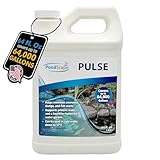
- IMPROVES WATER CLARITY: PondScape Pulse Liquid enhances transparency in your pond by breaking down excess fish food and waste. Ideal for koi ponds and water gardens, it promotes a clear and visually appealing aquatic environment.
- SUPPORTS A BALANCED ECOSYSTEM: This formula features a powerful combination of 7 beneficial strains, designed to minimize debris and waste build-up. It's essential for maintaining a balanced and thriving pond environment, even in fluctuating seasonal conditions.
- GENTLE ON FISH AND PLANTS: PondScape Pulse is formulated to be mild and compatible with koi fish and aquatic plants. Its blend works to maintain pond health and keep water in ideal condition, even when the temperatures drop to 37°F (2.8°C).s.
- EASY APPLICATION: With just 1 oz needed for every 1,000 gallons, PondScape Pulse offers simple and efficient use. The 64 oz bottle is compatible with the Dosing System XT, allowing for easy application while improving water clarity and maintaining pond health.
- IDEAL FOR LARGE PONDS: Designed for large outdoor ponds or water gardens, PondScape Pulse works efficiently in expansive water features. It helps minimize sediment build-up and elevate overall water quality, simplifying pond maintenance and upkeep.
Why Does Aeration Make Such a Difference to Water Clarity?
Aeration is the foundation of good pond water quality. Without it, every treatment you apply works at a fraction of its potential. The reason is straightforward: most of the biological and chemical processes that maintain water clarity are aerobic — they require dissolved oxygen. Beneficial bacteria, natural decomposition cycles, and even fish immune function all depend on adequate DO levels in the water column.
Algae, by contrast, strongly prefers still, stratified water. Aeration disrupts the calm surface conditions that planktonic algae thrives in, while simultaneously boosting the dissolved oxygen levels that beneficial bacteria need to outcompete algae for nutrients. It delivers a double benefit: making conditions worse for algae and better for everything that controls it.
Warm water also holds less dissolved oxygen than cold water — critical knowledge for summer pond management. At 25°C (77°F), water holds about 8.3 mg/L of oxygen at saturation; at 30°C (86°F) this drops to just 7.5 mg/L. Combined with increased fish metabolism and the extra oxygen consumed by decomposing organic matter in summer, this means your aeration needs are highest exactly when algae growth is most active. A quality air pump, fountain, or waterfall running continuously is the best insurance policy for both fish health and long-term water clarity.
Do Aquatic Plants Help Clear Pond Water?
Aquatic plants are one of the most underrated tools for maintaining clear pond water — and they require zero chemical input. Plants directly compete with algae for the dissolved nutrients that cause blooms: nitrogen and phosphorus. A pond with well-established aquatic plants consistently has lower nutrient concentrations and less algae pressure throughout the season.
Research cited by both Fondriest Environmental and the University of Florida IFAS indicates that coverage of 50% or more of a pond’s bottom surface area with submerged aquatic plants can dramatically reduce turbidity caused by algal blooms. You don’t need to reach that threshold to see meaningful benefit — even 20–30% plant coverage makes a measurable difference to nutrient levels and water clarity.
The most effective plants for water clarity are submerged oxygenators like hornwort or curly pondweed, which release oxygen directly into the water column and absorb nutrients through their leaves. Floating plants like water lilies add valuable surface shade that limits the light available for algae growth. Marginal plants at the pond edge intercept and filter surface runoff before it enters the water column with its nutrient load.
- Hornwort (Ceratophyllum demersum): Fast-growing submerged oxygenator with excellent nutrient absorption — one of the best choices for reducing algae pressure
- Water lily (Nymphaea spp.): Surface shade coverage limits algae light access; provides habitat for beneficial organisms
- Water hyacinth (Eichhornia crassipes): Aggressive nitrogen and phosphorus uptake; floats freely and requires no planting
- Yellow iris (Iris pseudacorus): Marginal plant that filters nutrient-rich runoff at the pond edge before it reaches open water
Step-by-Step: How to Clear Cloudy Pond Water in 2026
Follow this sequence regardless of the initial cause. Steps one and two apply universally — from step three onwards, select the path that matches your jar test result.
- Run the jar test first. Fill a clear glass jar with pond water and leave it on a sunny windowsill for 24 hours. Identify which cloudiness type you are dealing with before purchasing any treatment — this single step prevents the most common and expensive mistakes.
- Check and improve aeration. Confirm your pump and filter are running 24/7. If you have a pond over 500 gallons with fish and no dedicated air pump, add one now. Aeration amplifies every other treatment — without it, most products underperform significantly.
- For green water: install or assess your UV clarifier. If you have one, check the bulb age (replace annually) and clean the quartz sleeve. If you don’t have one, size a UV clarifier to your pond volume and run it continuously — green water will clear in 5–7 days.
- For clay or sediment: apply a flocculant. Choose agricultural lime (for low-hardness ponds), gypsum (pH-neutral ponds), or a commercial product like API ACCU-CLEAR. Apply as directed, then do not disturb the pond bottom for 48 hours.
- For organic cloudiness: apply beneficial bacteria. Follow product dosing instructions and maintain weekly doses for the first month. Run aeration at maximum output during the treatment period to support bacterial activity.
- Reduce the nutrient source immediately. Cut fish feeding to once daily — only what fish consume in five minutes. Remove decaying leaves, dead plant matter, and any uneaten food. No treatment will hold long-term if nutrient inputs remain unchanged.
- Add aquatic plants. Even a few pots of submerged oxygenating plants make a measurable difference within a few weeks. Target 20–30% surface coverage to start, working toward 50% coverage over the season for sustained results.
Best Products for Clearing Pond Water in 2026
These three product types consistently deliver results across different cloudiness causes. Confirm your cloudiness type before purchasing — using the wrong product is a common and frustrating mistake.
| Product Type | Best For | Typical Speed | Chemical-Free? |
|---|---|---|---|
| UV Clarifier (e.g. TetraPond GreenFree 18W) | Green algae cloudiness | 5–7 days | Yes |
| Liquid Flocculant (e.g. API ACCU-CLEAR) | Clay or sediment cloudiness | 24–72 hours | Low chemical |
| Barley Extract (e.g. CrystalClear) | Algae prevention and maintenance | 2–4 weeks (preventive) | Yes |
UV Clarifier — TetraPond GreenFree 18W (ASIN: B00474BFOU): Handles ponds up to 4,400 gallons. Uses a UV-C lamp to destroy algae cells as water passes through, with complete clearing typically achieved within 5 days. Replace the bulb annually — UV output degrades substantially after 12 months regardless of whether the light still illuminates.
Liquid Flocculant — API Pond ACCU-CLEAR (ASIN: B001D0Y9RG): A fast-acting flocculant that causes suspended clay and organic particles to clump together, settling to the bottom or being removed by filtration. Safe for fish and plants when used as directed. Treats up to 3,000 gallons per 4 fl oz dose, with visible results in most ponds within 24–72 hours.
Barley Extract — CrystalClear Natural Barley Extract (ASIN: B0D2MDDS49): An all-natural liquid concentrate derived from fermented barley. Fish and plant safe, effective in water temperatures above 50°F, and suitable for ponds, koi water gardens, and ornamental fountains. Dose monthly through spring and summer as a preventive maintenance treatment once your pond is clear.
What Mistakes Make Cloudy Pond Water Worse?
Even experienced pond owners can accidentally make cloudiness significantly worse. These are the most common errors to avoid in 2026.
- Overfeeding fish. Uneaten food sinks to the pond floor, decomposes, and releases exactly the nitrogen and phosphorus that drives algae blooms and organic cloudiness. Feed only what fish can consume in under five minutes, once daily during warmer months.
- Treating without diagnosing first. Applying algaecide to a clay turbidity problem — or a flocculant to green algae water — wastes money and can actively harm your pond ecosystem. Run the jar test before spending anything on treatment.
- Killing a large algae bloom all at once with chemical algaecide. Dumping algaecide into a severely green pond causes mass algae die-off. The decomposing algae then consumes large amounts of dissolved oxygen, potentially crashing DO to dangerous levels within hours. If using algaecide, treat a small section of the pond at a time over several days — never dose the entire pond at once.
- Turning the pond pump off overnight or seasonally. Dissolved oxygen is lowest at dawn. Running your pump continuously is non-negotiable if you have fish, and is essential for maintaining the aerobic conditions that support every biological water clarity process.
- Treating the symptom without fixing the cause. UV clarifiers and bacteria treatments will require constant reapplication if you don’t address the nutrients driving cloudiness. Reduce fish stocking, improve filtration, and eliminate external nutrient inputs to achieve lasting results.
Frequently Asked Questions About Cloudy Pond Water
How long does it take to clear cloudy pond water?
It depends on the cause. Clay turbidity treated with a flocculant typically clears within 24–72 hours once particles settle. Green algae water treated with a UV clarifier usually clears in 5–7 days of continuous operation. Organic cloudiness treated with beneficial bacteria shows initial improvement within 48 hours, with full long-term results achieved over 4–8 weeks of consistent treatment.
Is cloudy pond water dangerous for fish?
It can be. Green algae cloudiness carries the highest immediate risk — a severe bloom can crash dissolved oxygen levels overnight, potentially killing fish within hours. Clay and sediment cloudiness poses a lower immediate risk but can clog fish gills over time and reduce immune function. Milky cloudiness from a bacterial bloom also indicates water chemistry problems that need urgent attention. Any reading below 4 ppm dissolved oxygen is a fish emergency requiring immediate aeration.
Why does my pond keep going cloudy after I treat it?
Recurring cloudiness almost always means you haven’t addressed the nutrient source. Overfeeding, overstocking, insufficient filtration, or runoff from nearby lawn fertiliser will cause cloudiness to return within weeks of any treatment. The most effective long-term strategy is to reduce nutrient inputs, add aquatic plants, and improve aeration — then use treatments to manage what the system can’t handle on its own.
Does rain make pond water cloudy?
Yes — heavy rain washes clay, silt, garden fertilisers, grass cuttings, and organic debris into the pond, often triggering multiple types of cloudiness simultaneously. Maintaining a good plant border around the pond edge, avoiding bare soil nearby, and keeping lawn fertiliser well away from the pond all significantly reduce post-rain cloudiness. A flocculant applied after heavy rainfall can quickly clear any resulting sediment turbidity.
Can I use tap water to dilute cloudy pond water?
A partial water change of 25–30% can help dilute nutrients and improve clarity temporarily. Always use a dechlorinator when adding tap water — chlorine and chloramine kill the beneficial bacteria in your biological filter, which can trigger a secondary cloudiness problem. Keep partial changes below 30% at a time to avoid stressing fish with sudden water chemistry shifts.
What is the single fastest way to clear cloudy pond water?
For green algae water, a UV clarifier running continuously clears most ponds within 5–7 days — nothing else matches it for speed and reliability without chemical intervention. For clay or sediment cloudiness, a commercial liquid flocculant applied as directed combined with 48 hours of undisturbed settling works fastest, typically within 24–72 hours. There is no single universal product that clears all types of cloudiness — accurate diagnosis always comes first.
Conclusion: Your 2026 Pond Clarity Action Plan
Clearing cloudy pond water is entirely achievable — the key is matching the right treatment to the right cause. Run the jar test today before spending anything. Then follow the appropriate path: UV clarifier for green algae water, flocculant for clay turbidity, or beneficial bacteria for organic cloudiness. Support every treatment with consistent aeration and improved pond management.
Here is a realistic four-week timeline for clearing most ponds in 2026:
- Week 1: Run the jar test. Confirm aeration is running 24/7. Apply the primary treatment matched to your cloudiness type. Reduce fish feeding immediately.
- Week 2: Assess progress. Add or reposition aquatic plants. Continue primary treatment. Remove any visible decaying organic matter from the pond floor and edges.
- Week 3: Begin preventive maintenance dosing of barley extract or beneficial bacteria to lock in clarity and prevent recurrence. Check UV bulb age if using a clarifier.
- Week 4: Evaluate nutrient sources. Adjust fish stocking levels or feeding regime if cloudiness was severe. By this point, most ponds should be visibly clearer — if not, return to the jar test to re-examine the cause.
Clear pond water is not a luxury — it is the foundation of a healthy, thriving pond ecosystem. Fish live longer, plants grow stronger, and beneficial wildlife is more likely to visit when water quality is good. With accurate diagnosis and the right treatment, most ponds can achieve and sustain clear water within a single month.