
A healthy pond requires a different approach in every season. Spring brings debris and bacteria restart; summer demands algae vigilance; fall calls for leaf management and feeding adjustments; winter requires safe dormancy. Master all four, and your fish, plants, and water quality will thrive year after year.
Some of the links in this article may be affiliate links. If you make a purchase through these links, we may earn a small commission at no extra cost to you. Thank you.
- Over 7 million ornamental ponds exist in North America — yet most pond problems trace back to missed seasonal transitions.
- Dissolved oxygen below 3 mg/L stresses fish; at 2 mg/L for just two hours, channel catfish face 36% mortality after pathogen exposure (Penn State Extension).
- A pond’s optimal pH window is 6.5–8.5 — outside this range, fish reproduction and immune function decline sharply.
- Spring cleanouts take 8–12 hours; summer upkeep averages 2–4 hours per week; fall shutdown requires 6–10 hours.
Why Does Seasonal Pond Maintenance Matter for Long-Term Pond Health?
Pond ecosystems are not static. As air and water temperatures shift across 30°C or more throughout the year, every biological process in your pond — from bacterial decomposition to fish metabolism to plant growth—responds in kind. Ignoring these transitions doesn’t just make a pond look worse; it triggers cascading problems that become expensive and difficult to reverse.
According to Pennsylvania State University Extension, the single most common cause of pond fish kills is insufficient dissolved oxygen — a problem almost always linked to seasonal events like summer algae die-offs, decomposing autumn leaves, or a sudden warm spell in early spring. Proactive seasonal maintenance eliminates most of these risks before they materialize.
Research from the Kentucky Department of Fish & Wildlife confirms that ponds with high, poorly managed nutrient loads exhibit low dissolved oxygen, erratic pH, low water clarity, and excessive nuisance vegetation — all conditions that peak in intensity at seasonal boundaries. A structured, season-by-season routine keeps nutrients in check before they reach critical levels.
Beyond water quality, seasonal maintenance protects your investment in infrastructure. Pumps that are improperly winterized crack. Filters clogged with autumn debris harbor ammonia spikes the following spring. UV clarifiers run inefficiently when their quartz sleeves are never cleaned. Treating pond care as a year-round discipline — rather than a summer-only hobby — saves money, preserves fish health, and keeps the pond visually stunning every month of the year.
What Spring Pond Maintenance Tasks Should You Complete First?
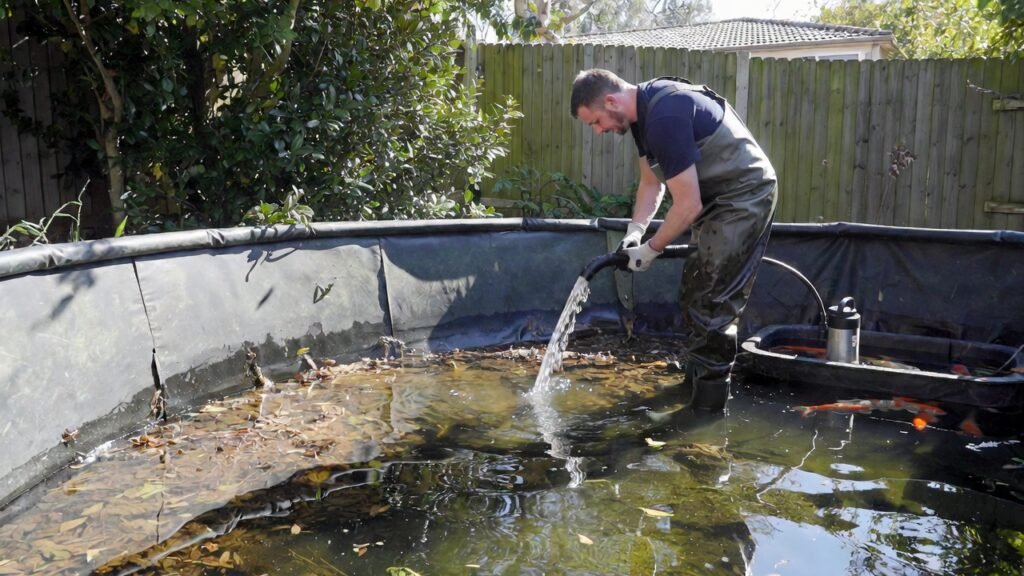
Spring is the most labor-intensive season for pond owners. As water temperatures climb above 10°C (50°F), fish emerge from their semi-dormant winter state, beneficial bacteria reactivate, and algae begin their aggressive growth cycle. Getting ahead of these changes in the first weeks of spring sets the tone for the entire warm season.
🌿 Spring Pond Maintenance Checklist
- Remove winter netting and any ice-damaged equipment
- Perform a full pond cleanout — drain, pressure-rinse, and remove sludge
- Inspect and clean pump impellers and housing
- Replace UV clarifier bulbs (effective life: 8,000–10,000 hours / approx. one season)
- Clean the quartz sleeve on UV clarifiers
- Reintroduce beneficial bacteria to re-seed the biological filter
- Treat fish for parasites and external bacterial infections before warm water accelerates pathogen activity
- Begin feeding fish once water temperature stabilises above 10°C (50°F)
- Divide and repot overgrown aquatic plants
- Test water parameters: ammonia, nitrite, pH, and KH
The spring cleanout deserves special attention. A full cleanout — draining the pond, removing fish temporarily, pressure-washing the liner, and clearing bottom sludge — takes between 8 and 12 hours for an average 3,000-litre garden pond. This work removes the decomposing organic matter that would otherwise fuel ammonia spikes and algae blooms throughout summer. According to pond specialists at The Pond Guy, ponds that receive an annual spring cleanout experience up to 60% fewer serious algae events over the following season.
Beneficial bacteria are the invisible workforce of your pond’s biological filter. They break down ammonia from fish waste into the less harmful nitrite and then into relatively safe nitrate. These bacteria become inactive below 10°C (50°F), meaning your filter bacteria colony effectively dies back over winter. Re-seeding the filter in spring — using a cold-water bacterial formula that remains active down to 4°C (39°F) — prevents the dangerous ammonia spikes that often kill fish in early spring before pond owners realize anything is wrong.
How Do You Keep Your Pond Healthy and Algae-Free in Summer?
Summer is the most biologically active period in any pond. Warmer water — typically 18–26°C (64–79°F) for UK and northern US gardens — accelerates fish metabolism, bacterial activity, and algae growth simultaneously. The challenge is keeping these forces in balance rather than letting any single element dominate.
Dissolved oxygen is the critical variable in summer. Warm water holds significantly less oxygen than cold water — at 25°C (77°F), water holds roughly 8.3 mg/L of oxygen at saturation, compared to 14.6 mg/L at near-freezing temperatures. Add high fish stocking, heavy plant respiration overnight, and increased bacterial oxygen demand, and your pond can dip below the 6 mg/L threshold that fish prefer—especially in the hours just before dawn. A quality air pump or venturi aeration system is not optional in summer; it is essential.
Algae management in summer requires a layered approach. No single method eliminates all algae forms — string algae (blanketweed) requires different treatment from green water algae, and surface film algae is a different problem altogether. The most effective summer strategy combines UV clarification (for green water), physical removal (for string algae), aquatic plant competition (for nutrients), and regular partial water changes of 10–15% every two weeks to dilute nitrates before algae can exploit them.
☀️ Summer Weekly Maintenance Routine (2–4 hours/week)
- Test water twice weekly: ammonia, nitrite, pH, and dissolved oxygen
- Clean filter media — in summer, biological activity fills filter pads faster
- Remove string algae by hand or with a brush; do not use copper-based treatments near koi
- Skim surface debris and dead plant matter daily if possible
- Check pump output — reduced flow signals a clogged impeller or blocked intake
- Monitor aeration and add supplemental air pumps during heatwaves
- Perform 10–15% water change every two weeks
- Feed fish 2–3 times daily — only what they consume in five minutes
What Fall Pond Maintenance Tasks Are Most Important?
Autumn is arguably the most consequential season for pond preparation. The decisions made between September and November directly determine how your fish, plants, and equipment survive winter — and how clean and balanced your pond is when it wakes up again in spring. Fallen leaves are the biggest threat: a single large tree can deposit enough organic matter to raise ammonia levels dangerously once leaves begin decomposing on the pond floor.
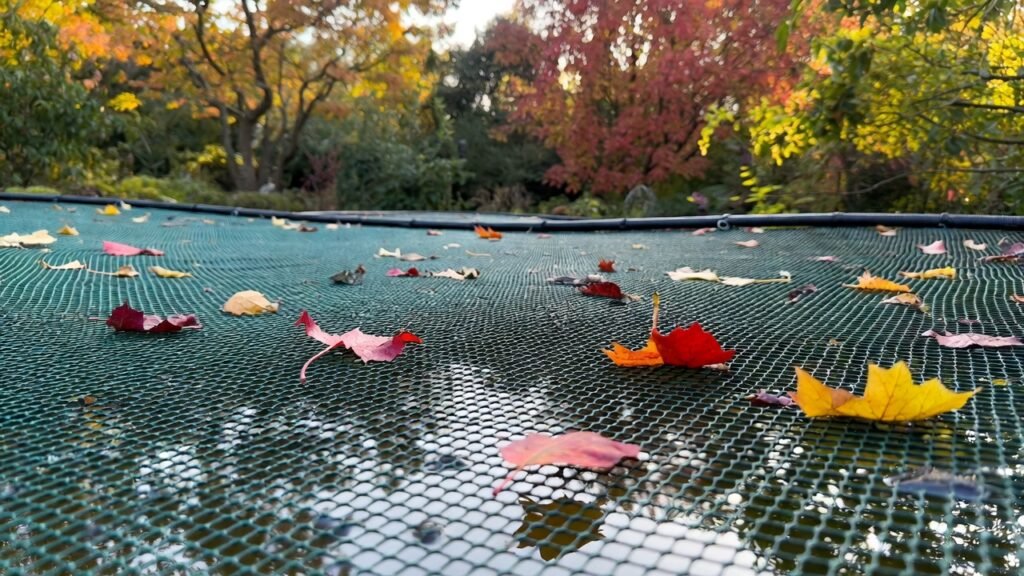
Pond netting is non-negotiable if deciduous trees overhang or surround your water garden. Fine-mesh netting stretched taut across the pond surface from mid-September captures leaves before they sink. Research from Aquascape indicates that ponds that are netted in autumn contain up to 80% less bottom sludge the following spring, directly translating to fewer algae problems and reduced spring maintenance time.
🍂 Fall Pond Maintenance Checklist
- Install pond netting before first leaf fall (mid-September in most temperate regions)
- Cut back marginal and bog plants to 5–8 cm (2–3 inches) above the waterline
- Remove, clean, and store tropical or tender aquatic plants indoors
- Reduce feeding frequency as water temperature drops below 15°C (59°F)
- Switch to a wheat germ-based food when temperature enters the low 60s°F (15–17°C range)
- Stop feeding entirely when water temperature falls below 10°C (50°F)
- Perform a partial water change and final water test of the season
- Begin planning any equipment upgrades before the spring rush
Feeding adjustments in autumn are critical for koi and goldfish welfare. Fish are cold-blooded, meaning their digestive systems slow in direct proportion to falling water temperatures. Food that sits undigested in a cold fish’s gut can cause infection and internal damage. The rule is straightforward: switch to a low-protein, high-carbohydrate wheat germ food when water temperature enters the low 60s°F (around 15–17°C), and stop feeding entirely below 10°C (50°F). Do not resume until spring temperatures stabilize back above this threshold.
How Do You Safely Winterize a Pond Step by Step?
Winterizing a pond is not simply about switching things off. Done correctly, it creates a stable, low-oxygen-demand environment where fish can safely overwinter and equipment survives frost without damage. Done incorrectly, it concentrates toxic gases under ice and puts fish under severe physiological stress.
❄️ Step-by-Step Pond Winterization Guide
- Stop feeding fish when water temperature falls and stays below 10°C (50°F).
- Remove, clean, and store UV clarifiers and large external pumps — water freezing inside housings will crack them.
- If keeping a pump running, move it to a shallower shelf (rather than the deepest point) so it circulates without disrupting the warmer deep-water layer where fish shelter.
- Install a pond de-icer or floating heater — not to warm the water, but to maintain a small ice-free hole for gas exchange.
- Never break ice by hammering — the shockwave can stun or kill fish. Use hot water or a de-icer to melt an opening.
- Keep the de-icer or aerator running to allow toxic gases (methane, hydrogen sulfide, carbon dioxide) produced by decaying matter to escape.
- Remove any remaining leaves or debris from the pond bottom before sustained freezing temperatures arrive.
- Check fish periodically — in very cold winters, reduce to once a week to avoid disturbing them.
Deep ponds (90 cm / 3 feet or deeper) provide natural frost protection. The deepest water in a pond stays near 4°C (39°F) even when surface ice forms, because water reaches its maximum density at this temperature and sinks. Koi and goldfish instinctively descend to this warmer zone and enter a torpor-like state of reduced metabolism. Shallower ornamental ponds in cold climates may require fish to be relocated to a frost-free indoor tank for the winter season.
How Do You Control Pond Algae Throughout the Year?
Algae is not a single enemy — it’s a category of organisms with different causes and solutions. Green water algae (suspended single-celled algae) turns pond water a pea-soup color and is best addressed with UV clarification. String algae (Spirogyra and similar filamentous forms) produces long green threads attached to rocks and the pond liner and responds best to physical removal combined with treatments like barley straw or hydrogen peroxide-based products. Knowing which type you have is the first step in treating it effectively.
| Algae Type | Peak Season | Primary Cause | Best Treatment |
|---|---|---|---|
| Green water (suspended) | Spring, early summer | High nutrients, new pond | UV clarifier, barley straw |
| String/blanketweed | Late spring, summer | High nitrates, bright light | Physical removal, iron-based treatments |
| Blue-green algae (cyanobacteria) | Hot summer | Very high nutrients, warm still water | Aeration, phosphate binders — seek professional advice |
| Surface film algae | Autumn, warm spells | Decaying organic matter | Surface agitation, skimmer, water change |
Aquatic plants are the most sustainable long-term solution to algae. Water lilies and other floating-leaved plants shade the water surface, reducing the sunlight algae needs to photosynthesize. Submerged oxygenating plants like hornwort (Ceratophyllum) and waterweed (Elodea) compete directly with algae for dissolved nutrients. Aim for aquatic plants to cover 50–60% of the pond surface area during peak summer, and you dramatically reduce the conditions algae needs to dominate.
What Water Quality Parameters Should You Test in Each Season?
Water testing is the diagnostic backbone of good pond management. You cannot manage what you do not measure. At minimum, every pond owner should test ammonia, nitrite, pH, and carbonate hardness (KH) — and in summer add dissolved oxygen and nitrate to the routine. Each parameter has seasonal risk windows where it is most likely to spike or crash, making targeted seasonal testing far more useful than random spot-checks.
| Parameter | Optimal Range | Highest Risk Season | Warning Sign |
|---|---|---|---|
| Ammonia (NH₃/NH₄) | 0 mg/L | Spring (filter restart), Autumn (leaf decay) | Fish gasping at surface |
| Nitrite (NO₂) | 0 mg/L | Spring (new season filter cycle) | Lethargic fish, red streaking on fins |
| pH | 6.5–8.5 | Summer (algae spikes pH high) | Wide daily pH swings (>1.0 unit) |
| Carbonate Hardness (KH) | >6° dKH | Any season | pH crash overnight |
| Dissolved Oxygen | >6 mg/L | Summer nights / heatwaves | Fish gasping at dawn |
| Nitrate (NO₃) | <40 mg/L | Late summer | Persistent algae, dull fish colour |
KH (carbonate hardness) deserves special attention because it is the pond’s buffer against pH swings. Heavy plant growth in summer consumes carbon dioxide during the day, pushing pH up — sometimes above 9.0 in a well-planted pond. At night, plants respire and release CO₂, pushing pH back down. Without adequate KH to buffer these swings, fish experience pH shock: a chronically stressful condition that suppresses immune function and makes them susceptible to every pathogen in the water. If your KH tests below 6° dKH, dose with sodium bicarbonate (baking soda) at roughly 1 teaspoon per 200 liters to raise buffering capacity.
How Do Water Temperatures Affect Koi and Goldfish Feeding Through the Seasons?
Feeding is one of the most powerful levers pond owners have over water quality. Uneaten food and fish waste are the primary sources of ammonia in a pond. Overfeeding in cool water — when fish metabolism has slowed but owners haven’t adjusted the schedule — is one of the leading causes of spring and autumn water quality crashes. A temperature-based feeding protocol eliminates this risk entirely.
| Water Temperature | Fish Metabolism | Feeding Frequency | Food Type |
|---|---|---|---|
| Below 10°C / 50°F | Dormant | Stop feeding entirely | None |
| 10–13°C / 50–55°F | Very slow | Once every 2–3 days (small portions) | Wheat germ (easy to digest) |
| 13–18°C / 55–65°F | Moderate | Once daily | Wheat germ or mixed diet |
| 18–26°C / 65–79°F | Peak activity | 2–3 times daily | High-quality growth or colour food |
| Above 28°C / 82°F | Stressed (low DO risk) | Reduce to once daily, small portions | Easily digestible food only |
Wheat germ-based foods are the cornerstone of transitional season feeding. Unlike high-protein growth foods, wheat germ pellets are rich in carbohydrates that fish can metabolize at lower body temperatures without the waste-heavy byproducts of protein digestion. A slow-metabolizing fish fed high-protein food in autumn will struggle to process it, leaving undigested food to rot in the gut and produce ammonia in the pond water. Switching to wheat germ when temperatures drop into the low to mid 60s °F (15–18°C) is one of the single most impactful adjustments a pond owner can make in autumn.

- BOOST FISH HEALTH: Artemiss is an expellant; it provides a beneficial treatment against ailments including: dropsy, fungus, milky skin, mouth rot, fin/tail rot
- HOW IT WORKS: supports the immune system and stimulates and accelerates regeneration of damaged tissue until no trace of the wound remains; will not cause buildup of future resistance
- ACCEPTABLE TO USE: acceptable to care for all aquatic life; It is a great aid to use as a stress reducer when acclimating fish to a new environment
- HOW TO USE: Shake thoroughly prior to use and switch off UV sterilizer, protein skimmer or ozone generators; Keep filters operational; Add dosage to water; Best results will be achieved if product is used soon after problem is detected
- NOTE: This product is intended for use with all ornamental and aquarium fish only, and may not be used for fish intended for human consumption

Which Pond Equipment Needs Seasonal Maintenance — and When?
Equipment failures rarely announce themselves in advance. A pump impeller gradually clogs with debris over summer until the flow rate drops 40% — usually noticed only when the waterfall slows. A UV clarifier bulb dims gradually to below effective output — noticed only when green water returns. A systematic, season-triggered approach to equipment maintenance prevents these slow-burn failures from becoming fish-killing crises.
| Equipment | Spring Tasks | Summer Tasks | Autumn Tasks | Winter Tasks |
|---|---|---|---|---|
| Pump | Clean impeller, check seals | Clear intake monthly | Service before shutdown | Remove or raise to shelf level |
| Filter | Rinse media in pond water, reseed bacteria | Clean every 2–4 weeks | Final clean before winter | Leave slightly wet if biological |
| UV Clarifier | Replace bulb, clean quartz sleeve | Check wattage and output | Clean sleeve before shutdown | Remove and store dry |
| Air Pump / Aerator | Test, replace diaphragms if weak | Run 24/7 in heatwaves | Maintain for gas exchange | Keep running for ice hole |
| Skimmer / Net | Clean basket, check weir | Empty basket 2–3x weekly | Check netting for leaf load | Remove if freezing likely |
UV clarifier bulbs lose approximately 40% of their germicidal output after 8,000–10,000 hours of use — even though they still emit visible light and appear to be working. For a pond running its UV 24/7 from April to October (roughly 4,380 hours), this means replacing the bulb every spring is not optional — it is the only way to ensure the unit is actually sterilizing free-swimming algae. Always pair a new bulb with a clean quartz sleeve; mineral and algae deposits on the sleeve reduce UV transmission to the water by up to 30%.
What Are the Best Products for Year-Round Seasonal Pond Maintenance?
The right tools make seasonal maintenance faster, more effective, and less stressful — for you and your fish. Below are the product categories that deliver the highest return on investment across all four seasons, along with specific recommendations trusted by pond professionals.
Water Testing Kit
A comprehensive liquid test kit (not strips, which are notoriously inaccurate for pond use) covering ammonia, nitrite, nitrate, pH, and KH is the foundation of informed pond management. The API Pond Master Test Kit is the industry standard for home pond owners and covers all critical parameters.

- Contains one (1) API POND MASTER TEST KIT Pond Water Test Kit 500-Test, including 6 bottles of testing solution, 3 color cards and 4 test tubes with cap
- Helps monitor water quality and prevent invisible water problems that can be harmful to fish
- Measures ornamental pond pH balance, Ammonia content, Nitrite levels and Phosphate content
- Contains six test bottles, instructions, glass test tubes and color charts for 500+ tests
- Use weekly for monitoring and when water or fish problems appear
Beneficial Bacteria Supplement
A cold-water bacterial formula that activates at 4°C (39°F) allows you to begin reseeding your biological filter in early spring rather than waiting until water warms above 10°C. This closes the dangerous window when fish are active but the filter isn’t yet cycling.
Pond Thermometer
Every feeding decision, every bacterial treatment dose, and every winterization decision should be driven by water temperature — not air temperature or calendar date. A floating or submersible pond thermometer costs under $15 and removes all guesswork from seasonal transitions.
Pond Netting
Heavy-duty polypropylene pond netting with a 7 mm mesh keeps leaves out in autumn while allowing rain through. Look for UV-stabilised netting with support hoops — flat netting that sags into the pond surface creates its own debris problem as leaves collect in the dips.
Case Study: From Green Soup to Crystal Clear Water in One Season
In spring 2024, a garden pond owner in Yorkshire, UK — running a 6,000-liter koi pond with 12 fish—contacted The Pond Guy’s consultation service reporting persistent green water that had lasted three seasons despite multiple algaecide treatments. Water tests revealed ammonia at 1.2 mg/L, nitrate above 80 mg/L, KH at just 4° dKH, and a pH that swung from 7.2 in the morning to 9.4 in the afternoon.
The diagnosis: a collapsed biological filter (never properly reseeded after installation), dangerously low KH allowing massive daily pH swings that kept killing the bacteria, and a UV clarifier with a three-year-old bulb operating at roughly 15% of its rated germicidal output.
The intervention involved a full spring cleanout, a new UV bulb and sleeve clean, daily KH dosing with sodium bicarbonate for two weeks until KH stabilized at 8° dKH, re-seeding the filter with cold-water bacteria, and a 30% water change to dilute accumulated nitrates. Within six weeks, ammonia and nitrite both read 0 mg/L, green water had cleared completely, pH swings narrowed to under 0.5 units daily, and fish color and activity visibly improved. The total cost of the intervention: approximately £85 in products and one full day’s labor versus the £600 the pond owner had spent on algaecides over three seasons without addressing root causes.
Frequently Asked Questions: Seasonal Pond Maintenance
When should I do a full pond cleanout?
Once a year, in early spring, before water temperatures rise above 10°C (50°F) and before fish become fully active. This timing minimizes fish stress (they are still semi-dormant), and removes the bottom sludge accumulated over winter before it starts producing ammonia and fueling summer algae growth. Heavily stocked or heavily planted ponds may benefit from a light partial cleanout in autumn as well.
How do I know if my pond needs more aeration?
The clearest sign is fish gasping at the surface in the early morning—particularly before sunrise in summer, when dissolved oxygen is at its daily minimum. Other indicators include lethargic fish, fish crowding around the waterfall or return jets, and murky water with a sulfur smell. If you see morning gasping even once, add aeration immediately—dissolved oxygen depletion can kill fish within hours.
Can I feed my koi in winter?
No. Once water temperature drops and stays below 10°C (50°F), koi and goldfish enter a near-dormant metabolic state and cannot properly digest food. Undigested food rots in the intestines, causing bacterial infections, and excess food in the pond spikes ammonia. Stop feeding completely and do not resume until spring water temperatures stabilize consistently above 10°C.
How often should I change pond water?
In summer, a 10–15% partial water change every two weeks is ideal for a stocked koi or goldfish pond. This dilutes accumulated nitrates and replenishes trace minerals without disrupting the pond’s beneficial bacterial colonies. In spring and autumn, a single 20–30% change as part of the seasonal transition is typically sufficient. Never change more than 25–30% in one go—large sudden changes cause temperature and chemistry shock.
What is the ideal pond depth for overwinter fish survival?
For temperate climates (UK, northern US, Central Europe), a minimum depth of 90 cm (3 feet) at the pond’s deepest point gives koi and goldfish access to the near-4°C layer where they shelter in winter. In climates where temperatures regularly drop to -15°C (5°F) or below, a depth of 120–150 cm (4–5 feet) provides a larger thermal buffer. Ponds shallower than 60 cm (2 feet) may freeze solid in severe winters and require fish to be moved indoors.
Why does my UV clarifier stop working over time?
UV clarifier bulbs degrade gradually — losing roughly 40% of their germicidal UV-C output by the time they reach 8,000–10,000 hours of use, even though they continue emitting visible light. Mineral and algae deposits on the quartz sleeve also block UV transmission to the water. Replace the bulb every spring and clean the quartz sleeve at the same time. If green water returns despite a running UV clarifier, these two items are the first things to check.
Conclusion: Your Seasonal Pond Maintenance Timeline for 2026
Seasonal pond maintenance is not complicated — but it is unforgiving of neglect at transition points. The fish kills, algae blooms, and equipment failures that plague pond owners almost always trace back to a missed spring restart, an ignored autumn leaf load, or a winter without adequate gas exchange. The framework below compresses everything in this guide into a single actionable annual timeline.
| Month (Northern Hemisphere) | Priority Actions |
|---|---|
| March–April | Full cleanout, UV bulb replacement, filter re-seeding, begin cold-water bacterial dosing, first fish treatment |
| May–June | Resume full feeding, establish weekly water testing, add aquatic plants, monitor for green water |
| July–August | Twice-weekly testing, manage aeration in heatwaves, biweekly water changes, string algae removal |
| September | Install pond netting, cut back plants, reduce feeding, switch to wheat germ food |
| October–November | Stop feeding below 10°C, final water change, remove or store UV clarifier, install de-icer |
| December–February | Maintain gas exchange hole, check fish weekly, plan spring equipment upgrades |
Follow this calendar, and you will spend less time reacting to emergencies and more time enjoying what ponds are actually for: a living, breathing centerpiece of your garden, at its best in every season. For more hands-on guides to pond building, filtration, and fish health, explore the full library at ThePodineer.com.