
Some of the links in this article may be affiliate links. If you make a purchase through these links, we may earn a small commission at no extra cost to you. Thank you.
Shrubs are the backbone of a thriving pond border. The right planting stabilises banks, filters nutrient-laden runoff, supports local wildlife, and delivers year-round beauty — transforming a muddy, eroding pond edge into a self-sustaining ecosystem that improves with every passing season. This guide covers everything you need to know to choose, plant, and maintain pond border shrubs in 2025.
📈 Key finding: Vegetated buffer strips incorporating woody shrubs can reduce phosphorus runoff into ponds by 40–60% and total nitrogen by up to 50%, according to research reviewed by Iowa State University Extension and published in peer-reviewed hydrology journals.
At a Glance
- Woody shrub buffer strips reduce phosphorus and nitrogen runoff by 40–60%, cutting algae growth at the source
- Native pond border shrubs require 60–80% less water and maintenance than conventional ornamental plantings once established
- Well-planted ponds with integrated shrub borders can increase property appraisals by 10–15%
- The right shrubs create a self-reinforcing ecosystem — stabilising banks, filtering water, feeding wildlife, and suppressing invasive weeds simultaneously
- Most native moisture-tolerant shrubs are established, low-maintenance, and self-sustaining within two to three growing seasons
What Are the Best Shrubs for Pond Borders in 2026?
The pond edge is one of the most ecologically dynamic zones in any garden — alternating between wet and dry, shaded and exposed, calm and turbulent. The best pond border shrubs in 2026 are overwhelmingly native North American species that have evolved to thrive in exactly these conditions. They combine deep, fibrous root systems with tolerance for seasonal flooding, saturated soil, and periodic drought — qualities that make them far more reliable than most ornamental alternatives.
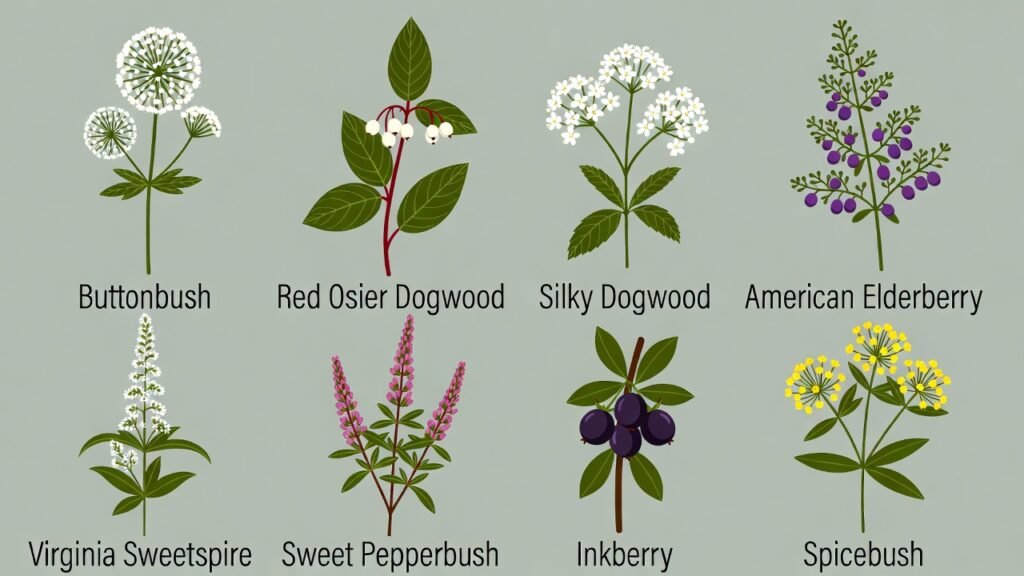
Buttonbush (Cephalanthus occidentalis) consistently tops expert lists. Its distinctive spherical white flowers attract bees, butterflies, and hummingbirds through mid-summer, while its dense root network locks in wet, silty pond bank soil better than almost any other native shrub. Red Osier Dogwood (Cornus sericea) brings extraordinary winter interest with fiery red stems and thrives in consistently moist conditions. Virginia Sweetspire (Itea virginica) delivers fragrant white flower racemes in early summer followed by some of the richest crimson-burgundy autumn colour of any moisture-tolerant shrub. American Elderberry (Sambucus canadensis), Sweet Pepperbush (Clethra alnifolia), Inkberry (Ilex glabra), and Silky Dogwood (Cornus amomum) round out a native palette covering every season, sun exposure, and pond zone. According to the USDA Natural Resources Conservation Service, native woody plants are among the most effective species for stabilising moist, disturbed soils along water margins, combining above-ground windbreak function with deep root anchoring.
| Shrub | Zones | Sun | Mature Height | Top Benefit | Wildlife Value |
|---|---|---|---|---|---|
| Buttonbush (Cephalanthus occidentalis) | 4–11 | Full–Part | 6–12 ft | Wet zone anchor, bee magnet | Ducks, bees, butterflies, hummingbirds |
| Red Osier Dogwood (Cornus sericea) | 2–8 | Full–Part | 7–9 ft | Winter colour, rapid erosion control | 40+ bird species eat berries |
| Silky Dogwood (Cornus amomum) | 4–8 | Full–Part | 6–10 ft | Fibrous roots for steep banks | Thrushes, waxwings, grouse |
| American Elderberry (Sambucus canadensis) | 3–9 | Full–Part | 8–12 ft | Edible berries, fast erosion cover | 50+ bird species, pollinators |
| Virginia Sweetspire (Itea virginica) | 5–9 | Full–Shade | 3–5 ft | Fragrant flowers, vivid fall colour | Butterflies, native bees |
| Sweet Pepperbush (Clethra alnifolia) | 3–9 | Full–Shade | 4–8 ft | Intensely fragrant summer flowers | Monarchs, bumblebees, goldfinches |
| Inkberry (Ilex glabra) | 4–9 | Full–Part | 5–8 ft | Evergreen structure, wet tolerance | Overwintering birds |
| Spicebush (Lindera benzoin) | 4–9 | Part–Full shade | 6–12 ft | Early spring colour, shade-tolerant | Spicebush swallowtail, thrushes |
How Do Pond Border Shrubs Actually Improve Water Quality?
Every garden pond faces the same invisible threat: nutrient-rich runoff. Rain carries nitrogen and phosphorus from lawns, flower beds, and hard surfaces into the water, triggering algae blooms that deplete oxygen and harm fish. Strategically planted shrubs create a biological buffer that intercepts this runoff before it ever reaches the water’s edge — and the science behind this is compelling.
Research published in Hydrobiologia (2025) and reviewed in a comprehensive 2024 meta-analysis in ScienceDirect confirms that vegetated buffer strips — even relatively narrow ones — reduce phosphorus runoff by 40–60% and total nitrogen by up to 50%. The mechanism is threefold. Plant roots absorb nutrients directly from the soil solution before they leach toward the water. Above-ground biomass slows the flow of surface water, giving fine particles time to settle rather than wash in. And critically, root systems support dense communities of soil microbes that actively transform and immobilise nitrogen — a process called denitrification — converting it from a water-polluting form into harmless atmospheric gas.
Shrubs outperform grass-only buffer strips because their root systems go deeper and wider. A mature buttonbush or silky dogwood can develop a lateral root network extending 4–6 feet from the stem base, intercepting runoff from a broad catchment area uphill of the pond. The 2024 ScienceDirect review found that buffer strips incorporating woody plants significantly outperform grass-only strips during heavy rainfall events — precisely when runoff is fastest and filtration most critical.
📈 Research from Iowa State University Extension shows that even a narrow 5-metre (16-foot) buffer strip of mixed shrubs and grasses meaningfully reduces nutrient and sediment concentrations — with wider strips providing considerably greater protection.
What Size and Spacing Do Pond Border Shrubs Need?
One of the most common mistakes in pond border planting is placing shrubs too close to the water’s edge. Most shrubs need at least 2–4 feet of clearance from the actual waterline to allow for fluctuating water levels, seasonal flooding, and root establishment in well-drained rather than permanently saturated soil. Understanding your pond’s margin zones is the key to getting this right.
Think of the pond perimeter in three distinct bands. The wet zone (0–12 inches from the waterline) is best reserved for emergent aquatic plants — rushes, sedges, and bog plants that can handle permanent moisture at their roots. The moist transition zone (1–4 feet from the waterline) is the prime shrub planting area: consistently damp but not submerged, with rich, organic soil and excellent moisture retention. Buttonbush, silky dogwood, and elderberry all thrive here. The dry upland zone (4+ feet from the waterline) supports a broader range of ornamental shrubs, including Virginia sweetspire, sweet pepperbush, and inkberry, which prefer good drainage despite their moisture tolerance.
For spacing, allow 5–8 feet between large shrubs (6–12 feet mature width) and 3–4 feet between compact varieties (3–5 feet mature width). Plant in informal clusters of three to five plants of the same species for a naturalistic effect — a single-file row looks artificial and is less effective at erosion control than a planted mass. Native groundcovers and low perennials planted between shrubs fill gaps quickly and prevent weeds from establishing in the mulched areas between plants.
How Do You Prepare the Site Before Planting Pond Border Shrubs?
Site preparation is the most overlooked step in pond border landscaping — and the one that most determines long-term success. Before ordering a single plant, assess your bank conditions: soil type, current vegetation, degree of slope, and drainage speed after rain. A simple jar test (soil shaken in water and left to settle into layers) will tell you whether your bank is clay-heavy, sandy, or loamy — information that directly shapes your plant choices and any soil amendments needed.
Clearing invasive vegetation is non-negotiable before establishing new shrubs. In many regions, pond edges are colonised by aggressive non-natives — common reed (Phragmites australis), Japanese knotweed, purple loosestrife, or multiflora rose — that will crowd out your new plantings within a season if not fully removed. Dig these out rather than spraying near water, and dispose of root material off-site. Even small fragments of knotweed or reed rhizome left in the soil will resprout.
For steep banks (greater than 15 degrees), install biodegradable erosion control fabric — coir fibre mesh or jute netting works well — along the waterline before planting. This stabilises the exposed soil immediately and degrades naturally over 18–24 months, by which time your shrub root systems will have taken over the job of bank anchoring. NC State Extension recommends combining woody plantings with a 25-foot transitional grass buffer between the upland garden and the shrub zone for maximum filtration effectiveness on sloped sites.
What Is the Step-by-Step Process for Planting Shrubs Along a Pond?
Follow this nine-step process for successful pond border shrub establishment. Spring (after last frost) and early autumn (September to mid-October) are the two optimal planting windows — autumn planting in particular allows roots to establish in cool, moist soil through winter before the demands of the first growing season begin.
- Mark your planting zones. Use bamboo canes and string to mark your wet zone, moist transition zone, and dry upland zone around the full pond perimeter before purchasing plants. This prevents the common mistake of buying species suited to the wrong zone.
- Test your soil pH. Most native pond border shrubs prefer slightly acidic conditions (pH 5.5–6.5). A basic home pH test kit (available at any garden centre) will confirm your reading. Add sulphur to lower pH; add garden lime to raise it. Allow four to six weeks for amendments to act before planting.
- Clear existing vegetation. Remove all competing plants, invasive species, and grass from the planting area. In compacted pond bank soils, fork over the surface to a depth of 8–10 inches before planting.
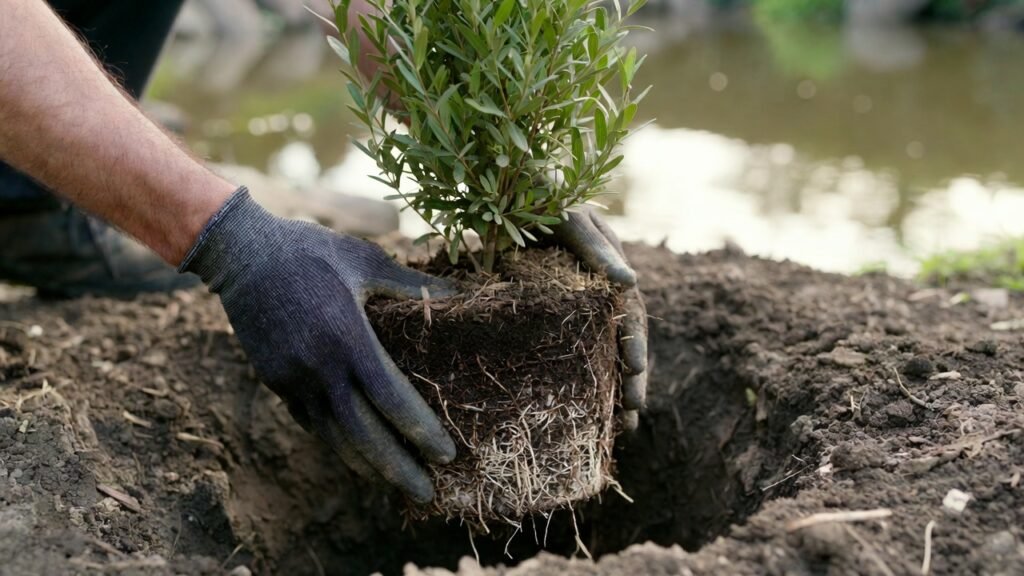
- Dig appropriately sized holes. Each planting hole should be 2–3 times wider than the root ball but the same depth — no deeper. In heavy clay bank soils, roughen the walls of the hole with a fork to prevent a glazed surface that roots struggle to penetrate.
- Loosen the root ball. For container-grown shrubs, gently tease apart any circling roots before placing in the hole. Circling roots left uncorrected will girdle the stem and weaken the plant over time.
- Position correctly. The top of the root ball should sit level with or 1–2 cm above the surrounding soil surface. Planting too deep — burying the stem base — is one of the leading causes of shrub failure in the first year.
- Backfill and firm. Return the excavated soil to the hole, pressing firmly in layers to eliminate air pockets. Do not add compost or fertiliser to the backfill in moist pond bank soils — excess nutrients leach directly into the pond. Use the native soil, full stop.
- Water thoroughly at planting. Even in moist pond bank soils, water each shrub deeply immediately after planting to settle the soil around the roots. During the first eight to twelve weeks, water every three to four days in dry spells — most native shrubs are not fully drought-tolerant until their root systems have established in year two.
- Apply organic mulch. Spread a 2–3 inch layer of wood chip or composted bark in a generous ring around each shrub, keeping mulch 3–4 inches clear of the stem to prevent rot. Mulch suppresses weeds, retains moisture, and regulates soil temperature through the critical first winter.
A soil moisture meter takes the guesswork out of watering during establishment — insert the probe 4–6 inches from the root ball to get an accurate reading of actual soil moisture rather than relying on surface appearance.
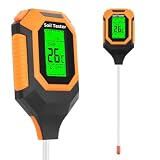
- 【4-in-1 Multi-Function】This 4-in-1 soil tester can sense soil pH/moisture/temperature/light more accurately and quickly. You can know the soil pH,Moisture,Temperature,Light that you care about by measuring it, so that you can take better care of our plants, so that they can be healthy and thrive after being well taken care of!
- 【Large green backlit LCD display】More accurate than the traditional dial soil tester test, test data can be more intuitively displayed on the screen. It greatly saves the trouble of reading, thus reducing the data error in use.This soil tester features a large LCD green backlit display that clearly shows and reads values day or night.This product requires AAA1.5V * 3 size batteries and will alert you when the batteries are low. (Batteries are not included in the soil tester.)
- 【More accurate and faster measurements】This soil meter probe uses the latest 2024 Soil Sensor Detection Technology to accurately and quickly detect the PH, moisture and temperature of your soil. The soil meter is also equipped with a light sensor to help you better understand the current light intensity of your plants. The new and improved technology allows you to better understand your soil and enjoy planting and harvesting.
- 【Easier to use】Simply insert the probe into the soil about 3-5 inches (10 cm) and wait 10-15 seconds to get an accurate reading of the soil. NOTE: When measuring soil, do not force the probe into dry, hard soil if the soil is too dry. (It is recommended that you water the soil test area and wait 10-15 minutes before testing or the tester will be damaged).
- 【Satisfaction After-Sale Service】When you have any questions and suggestions about this Soil Moisture Meter in the process of use, we will listen to your questions and solve your problems quickly. We will help each customer to deal with any problems on the product!
Which Shrubs Are Safe for Ponds with Fish and Wildlife?
Not all ornamental shrubs are pond-safe. Several popular garden favourites are toxic to fish, amphibians, or the wildlife you are trying to attract — particularly those with heavily falling foliage or berries that decompose in the water and release harmful compounds. Before purchasing any shrub for a pond border, verify its safety profile for aquatic life.
The following native species are confirmed safe for wildlife ponds and fish ponds based on ecological research and established horticultural guidance: Buttonbush — seeds eaten by ducks, nectar serves native bees and hummingbirds; American Elderberry — non-toxic berries eaten by over 50 bird species, flowers attract bees and butterflies; Virginia Sweetspire — non-toxic to all pond wildlife, highly attractive to pollinators; Red Osier Dogwood — white berries eaten by more than 40 bird species with no toxicity to fish or amphibians; Inkberry — persistent black berries are an important food source for overwintering birds; and Sweet Pepperbush — intensely fragrant flowers are a critical late-season nectar source for monarch butterflies and native bumblebees.
Shrubs to avoid near ponds include Rhododendron and Azalea — leaves and flowers are highly toxic to fish and most vertebrates; Yew (Taxus spp.) — among the most toxic plants to fish, birds, and mammals, with falling needles lethal at low concentrations; and Cherry Laurel (Prunus laurocerasus) — releases hydrogen cyanide as leaves decompose in water. All three are widely sold in garden centres and frequently planted near water without awareness of the risk they pose.
How Do Shrubs Help Control Pond Bank Erosion?
Bank erosion is among the most serious structural problems facing garden pond owners — particularly those on sloped sites or in areas with high rainfall. Unplanted banks lose topsoil with every rain event, silting the pond floor, clouding the water, and eventually causing bank collapse at the waterline. Shrubs are the most effective long-term solution available, and their impact is measurable within a single growing season.
Native shrubs like red osier dogwood and silky dogwood develop fibrous root systems that extend 4–6 feet laterally and 2–3 feet deep within three growing seasons. These root networks create a living mat that binds soil particles together, dramatically reducing surface erosion even on steep slopes. Research from Bright Lane Gardens and confirmed by USDA plant material studies identifies these two dogwood species as among the fastest-establishing native shrubs for wet-bank erosion control in North America. Their spreading habit — sending up new stems from spreading roots — means a single plant becomes a planted mass within two to three years.
📈 According to research published in PLOS ONE on riparian buffer strip vegetation, woody shrub buffer strips can reduce total suspended solids in runoff by 40–85%, with the highest reductions recorded on steeper slopes where erosion risk is greatest.
🌿 Real-World Results: The Ridgeway Garden Pond, Zone 6b
A homeowner with a 1,200-square-foot garden pond on a 20-degree slope experienced severe bank erosion, losing an estimated 3–4 inches of bank edge each year. Water clarity averaged just 8 inches of Secchi depth during summer, and algae blooms appeared every June without fail.
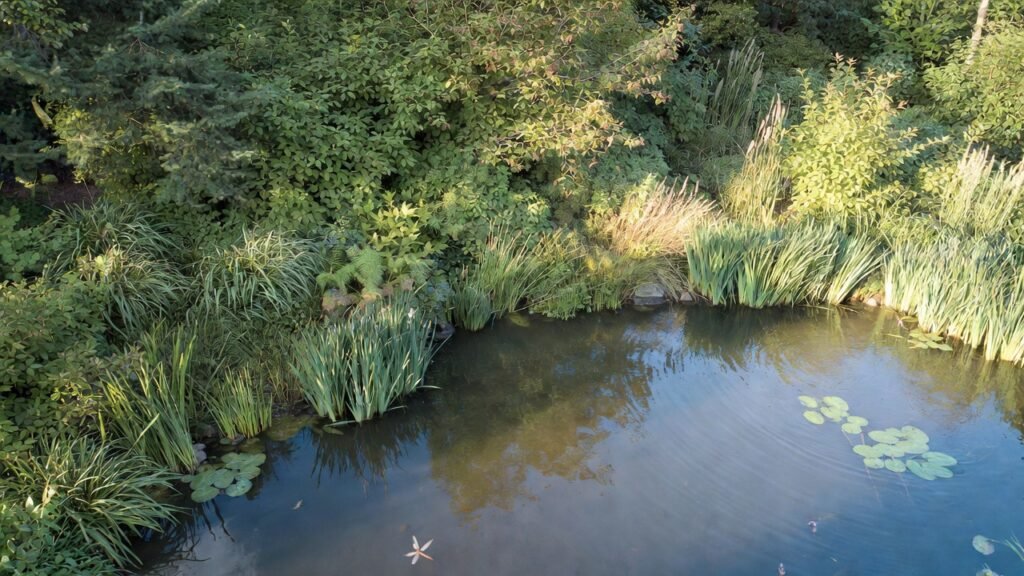
Over 18 months, a mixed native shrub border was established along three sides of the pond: red osier dogwood and silky dogwood in the moist transition zone, Virginia sweetspire and inkberry in the dry upland zone, with native sedges and blue flag iris at the waterline. The results after two full growing seasons:
- Bank erosion reduced to near-zero in all planted sections
- Estimated pond sediment accumulation fell by 65%
- Water clarity improved from 8 inches to 26 inches Secchi depth
- Summer algae blooms ceased without any chemical intervention
- Dragonfly, frog, and bird activity increased visibly — providing natural mosquito control
Total establishment cost was under $400 in plants and materials. No ongoing chemical treatments have been needed since planting.
What Are the Best Shrubs for Year-Round Pond Interest?
A well-designed pond border delivers something beautiful in every season. The best native shrubs make this almost effortless — each one contributing at a different time of year so that the planting is never static, never dull, and always ecologically active.
Spring opens with spicebush (Lindera benzoin), whose tiny yellow flowers emerge before any leaves appear — one of the very first nectar sources for early-emerging queen bumblebees. Red osier dogwood leafs out in vivid apple-green, and Virginia sweetspire begins its rapid growth phase, fattening up for its summer flowering display.
Summer belongs to sweet pepperbush and buttonbush. Sweet pepperbush earns its “summersweet” common name with intensely fragrant white flower spires from July through August — a scent detectable yards away. Buttonbush follows in mid-summer with its remarkable golf-ball-sized white flowers, buzzing with bees for weeks. Elderberry is heavy with dark purple-black fruit clusters by late summer — a feast for birds that arrive in flocks.
Autumn is Virginia sweetspire’s finest hour. Its foliage turns crimson to burgundy with a richness that rivals any ornamental maple, and it often holds colour well into November. Red osier dogwood’s leaves turn reddish-purple before dropping to reveal their winter trick. Inkberry’s glossy black berries ripen and persist through autumn, sustaining migrating and resident birds through the lean season.
Winter is red osier dogwood’s season to shine. The bare stems intensify to a striking scarlet-red against snow, frost, or bare soil — one of the most dramatic winter effects in any garden. Inkberry holds its evergreen foliage and persistent berries through the coldest months, providing structure and a critical food source for birds when little else is available.
How Do You Maintain Pond Border Shrubs Without Disrupting the Ecosystem?
Native pond border shrubs are among the lowest-maintenance plants in the garden once established. But some well-timed annual attention pays real dividends in health, appearance, and wildlife value — and a little knowledge about what not to do is equally important near a pond.
Pruning: Most native moisture-tolerant shrubs benefit from light renewal pruning in late winter or very early spring, just before new growth begins — typically February to early March in most of the UK and zones 5–7 in North America. For red osier dogwood, remove the oldest third of stems at ground level each year (a technique called coppicing). This continually regenerates the plant with young, intensely coloured stems and prevents the centre of the shrub from becoming woody and bare. Avoid autumn pruning — you will remove overwintering habitat for beneficial insects, many of which nest in hollow stems or under bark.
Mulching: Replenish organic mulch each spring to maintain a 2–3 inch depth in planting beds. As wood chip breaks down over the season, it feeds the soil food web, improving structure and water retention without adding soluble nutrients that could reach the pond. Keep mulch 3–4 inches clear of shrub stems to prevent the crown rot that can occur when organic material is piled against woody tissue.
Feeding and watering: Native shrubs established in appropriate conditions genuinely do not need fertilising. If a shrub displays persistently yellow leaves, investigate the underlying cause — poor drainage, soil compaction, or pH imbalance — rather than applying fertiliser near the water’s edge. Established native shrubs will thrive on natural rainfall in most regions after their second full growing season. A quality pair of bypass pruning shears makes light work of annual maintenance without crushing or splitting woody stems.

- Includes 10lb block of Back to the Roots compressed Coconut Husk Mulch that expands to over 2 cubic feet of mulch. Use it for gardens, raised beds, pet bedding and more
- Expands to over 2 cubic feet
- Peat Free OMRI Listed, assuring organic production, handling, and processing
- 100% SATISFACTION GUARANTEE: If you are not satisfied or have any issues with this Organic Coconut Mulch, just shoot us a note and our dedicacted customer support team will make sure we get you growing or send you a refund/replacement.
- GROWONEGIVEONE — Share a photo of your growing garden and we’ll donate a Grow Kit and STEM elementary school curriculum to a classroom of your choice.

What Are the 2026 Trends Shaping Pond Border Design?
2026 marks a meaningful inflection point in how homeowners and landscape designers approach pond borders. Three powerful trends are reshaping the space — and all three point toward shrub-led, ecologically grounded planting.
Native-first planting is the dominant shift. According to smartpond.com’s 2026 garden trend report, native plants are now the first choice for pond surrounds — valued equally for ecological function and their dramatically lower maintenance profile. Once established, native shrub borders require 60–80% less water and maintenance than conventional ornamental plantings. This shift is being driven by both environmental awareness and practical economics: homeowners are tired of high-input landscapes that demand constant intervention.
Layered naturalistic design is replacing formal lines. Rather than a single row of matching shrubs, 2026 pond borders are conceived as layered ecosystems — canopy-scale shrubs (elderberry, buttonbush) at the outer edge, mid-height flowering shrubs (sweetspire, pepperbush) in the middle band, and low native groundcovers and sedges at the waterline. This multi-layered approach mirrors the structure of a natural pond margin and dramatically increases wildlife value, aesthetic complexity, and erosion resilience.
Property value awareness is growing. Homeowners are increasingly aware that well-landscaped water features are a tangible financial asset. Landscaping industry reports from 2024 and 2025 consistently show that homes with professionally landscaped ponds command 10–15% higher appraisals and sell for 5–15% above comparable homes without water features. The addition of a shrub border — which signals ecological intentionality and low-maintenance design — appears to strengthen that premium further.
📈 Homes with professionally landscaped ponds and native plant borders can achieve appraisals 10–15% above comparable properties, and regularly sell for 5–15% more — according to multiple 2024–2025 landscaping industry analyses.
Looking ahead to 2026, expect continued growth in rain garden integration with pond borders, smart irrigation systems calibrated to pond water levels, and a strong focus on shrub species that support threatened native bee and monarch butterfly populations. The pond border of 2026 will be designed as wildlife infrastructure, not just landscape decoration.
Frequently Asked Questions About Pond Border Shrubs
How close to the water can I plant shrubs?
Most shrubs should be planted at least 2–4 feet from the actual waterline, in the moist transition zone rather than the permanently wet zone. The main exception is buttonbush (Cephalanthus occidentalis), which naturally colonises the wet zone and can tolerate short periods of partial inundation — making it an ideal choice for the immediate pond edge where other shrubs would struggle.
Will shrub roots damage my pond liner?
This is a common and understandable concern. The reassuring answer is that most native shrubs grow roots toward moisture and oxygen — which means they naturally follow soil drainage pathways downward rather than horizontally into liner material. Maintaining a planting distance of 2–4 feet from a liner edge provides good protection in most cases. For complete peace of mind, install a rigid polypropylene or HDPE root barrier 12–18 inches deep between your shrubs and the liner edge.
Is spring or autumn better for planting pond border shrubs?
Both windows work well, and the best choice depends on your climate. Spring planting (after last frost, when soil has warmed) allows shrubs to establish through the growing season with warmth and long days supporting root development. Autumn planting (September to mid-October) takes advantage of cool, moist soil and consistent rainfall — roots establish strongly during autumn and winter dormancy, leaving the plant primed for vigorous growth the following spring. Avoid planting in peak summer heat, when moisture stress makes establishment significantly harder.
How many shrubs do I need per linear foot of pond edge?
For medium-sized native shrubs (5–8 feet mature spread), one plant per 4–5 linear feet of bank gives good coverage within two to three growing seasons. For faster impact or on a steep, erosion-prone bank, plant at closer spacing — one plant per 3 feet — and thin after three years if crowding occurs. Always plant in informal clusters of three to five plants of the same species rather than a regimented single-file row. Clustered planting is more effective for erosion control and looks far more naturalistic.
What is the fastest-establishing native shrub for pond bank erosion control?
Red Osier Dogwood (Cornus sericea) is consistently the top recommendation for rapid establishment on wet pond banks. It roots quickly, spreads naturally via stem layering, and begins providing meaningful erosion protection within a single growing season. Its vigour and spreading habit mean you will need to manage its expansion in smaller gardens — install a root barrier or plan for annual thinning — but for large or severely eroding banks, this speed and reliability make it the right first choice.
Can I grow shrubs on a very shaded north-facing pond bank?
Yes — several native pond border shrubs perform exceptionally well in partial to full shade. Virginia sweetspire (Itea virginica) is one of the most shade-tolerant flowering shrubs in the native palette, delivering full flower and autumn colour performance even in dense shade. Spicebush (Lindera benzoin) is a natural woodland understory plant that thrives on north-facing, shaded banks. Inkberry (Ilex glabra) also tolerates shade well and provides year-round evergreen structure where few other shrubs perform reliably.
Your Next Steps for a Thriving Pond Border
Creating a healthy, beautiful pond border with shrubs is one of the highest-impact investments you can make in your water garden. The right shrubs filter your water naturally, anchor your banks permanently, feed your local wildlife generously, and deliver year-round structure and seasonal colour — all while becoming more self-sufficient, more resilient, and more valuable with every passing year.
Start by choosing three to five native species suited to your climate zone and pond conditions. Focus first on your moist transition zone, planting your largest native shrubs — buttonbush, red osier dogwood, or silky dogwood — where the soil stays consistently damp. Layer mid-sized flowering shrubs like Virginia sweetspire and sweet pepperbush behind them, and finish the waterline with native sedges, rushes, or blue flag iris. Fill the mulched ground between shrubs with native groundcovers like creeping phlox or golden groundsel to close the canopy against weeds.
Give your planting two full growing seasons before drawing conclusions. Native shrubs follow the old gardener’s wisdom: “first year they sleep, second year they creep, third year they leap.” By year three, you will have a self-sustaining, self-repairing living border that improves your pond’s health, appearance, and wildlife value season after season — with minimal intervention from you.
Your Implementation Timeline
- Month 1: Assess your site, identify zones, test soil pH, and clear all invasive vegetation
- Month 2–3: Plant your chosen native shrubs; apply organic mulch; install root barriers where needed
- Month 4–12: Water during dry spells; hand-weed mulched areas; monitor for invasive re-establishment
- Year 2, late winter: Begin renewal pruning of dogwoods; replenish mulch in spring
- Year 2, growing season: Observe wildlife activity; note any gaps to fill with additional native groundcovers
- Year 3 and beyond: Enjoy a thriving, low-maintenance pond border ecosystem that manages itself
For more expert guidance on pond planting, water quality management, and water garden design, explore The Pondineer’s complete resource library at thepondineer.com.